
By Habila Ibrahim, Abuja | Published on November 24, 2026.
Introduction
When exploring the cultural history of West Africa, some communities immediately attract attention because of their colourful festivals, ancient customs and remarkable relationship with nature. Some are especially remarkable because they have been able to maintain significant elements of their parental identity after centuries of social, religious and political evolution. The second group to which belong the Jola, also called Diola.
Living mainly in the Casamance region of southern Senegal and across parts of The Gambia, the Jola are among the communities whose cultural heritage reflects a deep connection between family, land, spirituality and community life. Jola history is not simply a story of where people came from. It is also a story of how generations developed their own ways of farming, organised their villages, celebrated important occasions and maintained relationships with the spiritual world.
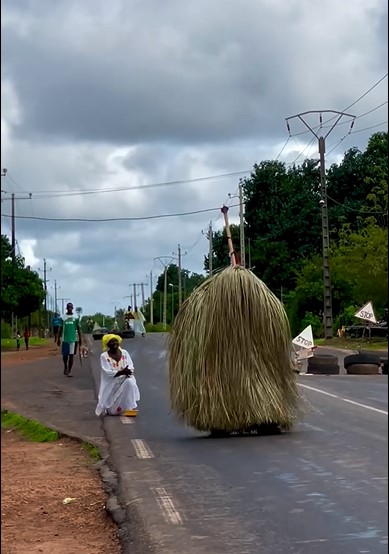
One of the most intriguing parts of the Jola heritage is the Kumpo masquerade. Its unusual appearance, mysterious movements and association with traditional spiritual beliefs have made it one of the most recognisable cultural performances in parts of Senegal and The Gambia.
What is interesting about the Jola is that their cultural identity is not rooted in any one tradition. The communities have different dialects, religions and individual customs. Some still follow traditional ancestral religious practices, others believe in one god and may practice Christianity or Muslim, and in some communities we see elements of both.
In this article, we will explore the history, origins, language, religion, food, marriage customs, festivals and traditional institutions of the Jola people. We will also look into why the Kumpo continues to be an important symbol of their cultural heritage.
History and Origin of the Jola People
The Jola are an established ethnic community of the Senegambia region, with important historical roots in the areas that are now southern Senegal, The Gambia and parts of Guinea-Bissau.
Their principal traditional concentration is in Casamance, around the towns of Ziguinchor and Oussouye and the rural areas behind them. Jola communities in The Gambia are mainly found in the Foni area of the southwest.
In contrast to other traditional West African communities whose past was linked to big state and empire building structures, most Jola’s history revolved around villages, family groups, elders and local agencies.
This village-based organisation helped communities manage farmland, family responsibilities, religious ceremonies and relationships with neighbouring settlements.
The precise early origins of the Jola people are still subject of debate. Different communities preserve their own accounts of ancestry, settlement and migration. One would be mistaken in saying that the Jola is a single group, coming from a specific ancestral homeland.
Also Read: Bekwarra People of Cross River
Pre-European colonization of the Casamance region by Jola groups can be traced back through records. Over time, movements of neighbouring populations, trade, warfare and religious influences contributed to the development of the wider Senegambian society.
The Jola also maintained relationships with Mandinka, Bainouk, Balanta, Serer and other neighbouring communities. These relationships included trade, cultural exchange, marriage and, at different periods, political and military tensions.
The land connection is an important part of their story. The Jola farmers have developed over generations sophisticated techniques of rice cultivation, especially in the wetlands and river valleys of Casamance.
For many families of the Jola people, the land was much more than a place to grow food. It represented family continuity, inheritance, responsibility and the connection between generations.
Where the Jola People Live
The Jola are found mainly in three neighbouring West African countries:
Senegal: The Casamance region is the principal historical centre of Jola communities. Important areas include Lower Casamance and settlements around Ziguinchor, Oussouye and Bignona.
The Gambia: The Jola are specific to Foni, comprising the villages from all over the western and southern parts of the country.
Guinea-Bissau: The Jola-speaking communities across the border and represent an integral part of the Jola linguistic group.
The geographical distribution of the Jola is especially interesting because modern international borders do not completely reflect their older cultural relationships.
Before the geographic boundaries of this nation were drawn, communities in this region traded, farmed, connected through kinship and kinfoms.
The region was divided by colonial powers into separate administrative units; whereas some related communities went under different colonial powers. Some of the relevant colonies were: Guinea Bissau under the Portuguese, Senegal under the French and The Gambia under the British.
These different colonial experiences influenced education, administration, religion and political development. Still the cultural connections continued across the borders.
The Meaning of the Name Jola or Diola
The names Jola or Diola are commonly used to refers to this ethnic group.
Jola and Joola are widely used forms, while Diola is the French spelling that became common in historical and administrative literature.
In the context of the subject of this article, the name Dialo should be considered in connection with some broader variations of names. When talking about the people, we will use the name Jola and Diola, as research and the authors often refer to both the names.
It is also important to understand that Jola is not the name of one completely uniform cultural group. The community includes several subgroups with their own languages or dialects, settlement histories and traditions.
Language of the Jola People
Language is one of the strongest foundations of Jola cultural identity.
Related languages of the Jola speak the Atlantic branch of the Niger-Congo language family. These languages speech varieties of languages that are associated with Fonyi, Kasa, Ejamat, Fogny, Gusilay and other communities.
These varieties have linguistic relation, but should not be treated as identical. Differences in pronunciation, vocabulary and everyday expressions can be significant.
In Senegal, French has an important place in formal education and government administration while in The Gambia, English is the official language. Mandinka, Wolof and other regional languages are also widely encountered in the wider Senegambian region.
For Jola families, however, indigenous languages remain important in everyday communication, storytelling, songs, family relationships and cultural ceremonies.
A senior citizen of that community may have difficulty expressing in a foreign language what the ritual originally meant. And this perhaps is one of the reasons why a person’s culture cannot be totally divorced from his or her language.
Traditional Religion and Spiritual Beliefs
Traditional Jola spirituality has historically been connected to the natural environment, ancestral relationships and the belief that human life exists alongside spiritual forces.
Some Jola societies have a supreme creator called Ata Emit. Sacred places, ancestral observances, shrines, protective objects and ceremonies associated with particular spiritual responsibilities may also be part of traditional religious practices.
The forest has an important place in several Jola traditions. Certain areas are regarded as sacred and are associated with initiation, traditional authority and spiritual knowledge.
The relationship between the living, the ancestors and the natural world is particularly important in understanding these beliefs.
Traditional spirituality is not exactly the same throughout Jola society. Communities have experienced different religious histories, and Christianity and Islam have become important among many Jola people.
There are some family groups that practise all their older customs, practising both their indigenous identities and their Christian or Muslim religions. Or there are family groups who only follow their existing religion, but do not adhere to all their older customs.
We cannot therefore say that all Jola are adherent to one traditional religion.
But the fact remains that the spiritual heritage of the original populations still remains part of the historical and cultural identity of most Jola communities.
The Kumpo: The Sacred and Mysterious Masquerade
The Jola people have many interesting traditions, one of which is the Kumpo masquerade.
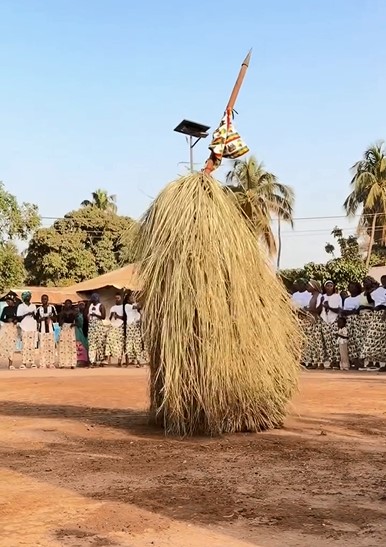
The Kumpo can look strange to someone seeing it for the first time. It is covered from head to toe with raffia palm leaves, and so it becomes a big moving figure whose human identity is hidden.
The masquerade is associated with spiritual beliefs and traditional performance institutions in parts of Casamance and The Gambia. It is not just a matter of appearance to entertain the spectators. In its traditional context it has cultural and symbolic meanings relating to the community.
Who or What is the Kumpo?
The Kumpo is a traditional masked figure associated with Jola cultural and spiritual life.
In some traditional beliefs, it is believed to be a spiritual being or an apparition of the unmanifested worlds, rather than a person in a suit.
This is another significant difference. The cultural interpretation of what the Kumpo is associated is that the individual hidden behind the mask does not embody the entity we know as a Kumpo.
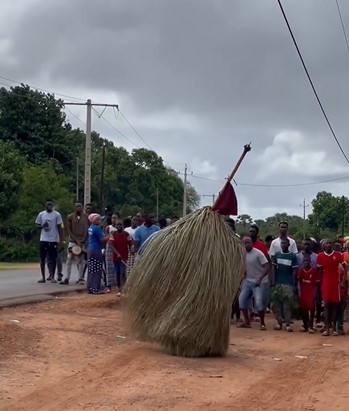
There is a performers’ mask, the costume conceals the performer, and the performance is formed by traditional knowledge and prescribed community practices.
Some Gambian cultural heritage descriptions relate the Kumpo with the devil while other academic interpretations discuss it as a spiritual intermediary or more-than-human presence. These things differ in their explanations and should not be interpreted as all being equally valid.
How the Kumpo Is Dressed
The looks of the Kumpo is certainly one of the most discernible features of the Kumpo.
The masked person wears a costume of raffia palm leaves that cover the whole body. The head covering is completed by a wooden stick that gives the masquerade its characteristic shape.
According to descriptions of the Gambian tradition which also mention the use of baobab-bark ropes to hold the raffia materials together.
The costume is traditionally prepared by an elder who is experienced in regard to the performance.
By complete costuming, the performer ceases to be just a person in public. He or she also ceases to be anyone in the persona of the Kumpo in the course of the ritual.
The Kumpo Dance and Performance
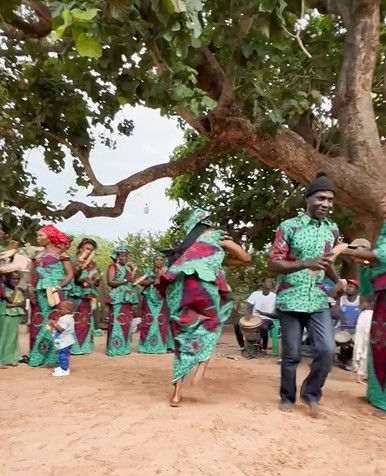
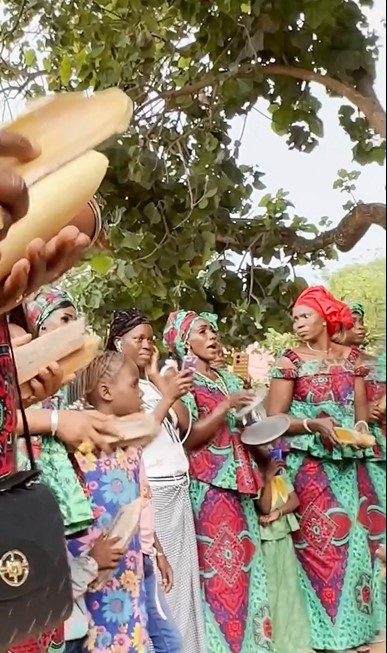
The performance usually takes place with traditional music, drumming, singing and dancing.
The drums get livelier and the Kumpo begins to circulate in the performance area, often spinning and showing some amazing physical control.
One of the interesting things is how the raffia costume moves. At some point during the dance, the performer can show great sense of balance and coordination while holding the costume in place.
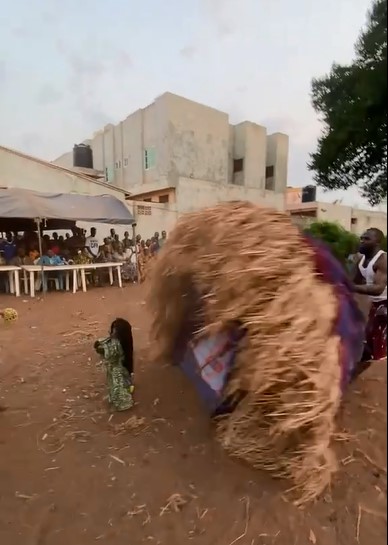
In a few shows, there is a scene where the Kumpo’s head is blown off and pops right back.
The community contributes through their participation in music, dance and observation. The performance may be part of a village ceremony, feast or cultural event, or similar.
The Cultural and Spiritual Importance of the Kumpo
The Kumpo should not be understood only as a dancing character.
In traditional communities it may be community building, a spiritual bastion, discipline and the transmission of ancestral practice.
The way it looks is a way to pass down cultures to their next generations.
On some occasions, the Kumpo gets his message out through an interpreter. The messages could be about everything from how people in the community should behave and perform their social obligations, to farming, to the impending feast or whatever is happening in the village.
The Kumpo is therefore connected to more than entertainment. It can be part of the way a community remembers its traditions and expresses collective identity.
Is the Kumpo a Mythological Figure?
The Kumpo can be discussed as a figure of traditional spiritual and mythological significance, but it is important not to invent a single ancient legend about its origin.
Its meaning is better understood through the different Jola communities that maintain the tradition, their sacred institutions and the explanations given by cultural custodians.
For some participants the Kumpo is a spiritual presence. For some the importance is expressed in its cultural, social and ceremonial roles.
Academic research by Ferdinand de Jong has also examined how the Kumpo has changed as it moved between village ceremonies and performances for tourists and cultural festivals.
Which bring us to an important question for modern African communities: how can we allow other people to learn from our history without losing the old value of it?
The Jola culture can be preserved, at least in part, if it is respected by those who safeguard it and believe that there are some sacred stories which cannot be freely told to the masses.
Traditional Agriculture and the Importance of Rice
Agriculture is one of the most important parts of traditional Jola life.
The Jola people are especially known for their long history of rice cultivation. Agriculture was established in the valleys, savannas and mangroves of Casamance.
The rice is more than just a crop in these communities. It has historical, economic and social importance.
Traditional rice farming requires knowledge of the seasons, water management, soil conditions and the organisation of labour.
Jola farmers developed methods of preparing wetland fields, controlling water movement and protecting farmland from excessive saltwater intrusion.
Jola women especially are vital to the production process, although the division of labor may differ from one community to another and between farming systems.
It is the best time to gather families and neighbourhoods in the field. Planting, field maintenance, harvesting and rice processing demand a lot of effort and attention.
In addition to rice, families grow other crops, including millet, groundnuts and vegetables, (subject to local conditions).
Livestock keeping, fishing and trading also contribute to the livelihoods of different communities.
The agricultural knowledge passed from one generation to another is one of the most valuable parts of Jola heritage.
Jola Traditional Food and Eating Habits
Food is another important way to understand the identity of a community.
Among the Jola, rice has a strong position especially because of its connection with traditional farming.
Rice dishes are commonly prepared with fish, vegetables, palm oil and locally available ingredients.
Depending on the location and household, meals may also include millet, maize, groundnuts, leafy vegetables and different kinds of sauces.
Fishing is important in some settlements, especially those located close to rivers, mangroves and coastal environments.
Food is prepared by family members and knowledge of healthy eating goes through generations.
A meal is not just satisfying hunger. It can also be a social event where relatives come together, catch up with family affairs and stay in touch.
Over time, contemporary foods and commercial ingredients have gained more popularity but the traditional farming produce still maintain a significant place in the food traditions of a large proportion of Jola households.
Marriage and Family Life Among the Jola
Marriage is an important social institution among Jola communities.
Marriage usually unites two families and makes two people related not only to each other, but to everyone else connected with both families.
Depending on local traditions family elders and relatives may be involved in marriage negotiations.
Marriage, however, is not the same for all the subgroups of the Jola. Marriages have been affected by religious views, local customs, education and formal legislative processes.
In some conventional contexts, negotiations for marriage take the form of exchanging regard and gifts between the families.
Marriage celebrations may include music, dancing, food and the participation of extended family members.
Family life is also strongly connected with respect for older people and responsibility towards younger generations.
Aunts, grandparents, great-grandparents, uncles and elders can be key to helping children learn family history, cultural values and roles, traditional knowledge, and relationships within the community.
Urbanisation and migration will continue to impact on present day households, but in particular the extended family remains a vital part of where you get your sense of identity and support from.
Traditional Festivals, Music and Dancing
Music and dance are integral parts of the Jola cultural life.
Celebrating together traditionally serve as an opportunity for people to unite, remember their history and continue building ties between families and their surrounding neighborhood.
Drums, singing and coordinated dancing are common features of different cultural performances.
Some ceremonies are connected with agricultural seasons, initiation, religious observances and community celebrations.
The Kumpo is among a group of traditional masquerade performances around the broader cultural setting. Don’t come to conclusion that it should be part and parcel of every Jola festival.
Different dances and performances have their own significance and origin story. Their importance may depend on the community, the occasion and the people responsible for organising them.
Music is also a form of oral history. Songs and performances are methods of passing on culture in a way that the next generations can remember.
Initiation, Sacred Groves and Traditional Institutions of Jola
One of the most significant aspects of some traditional Jola communities is the institution of initiation.
Initiation ceremonies have historically been associated with the transition into adult responsibilities, the acquisition of cultural knowledge and membership in particular community institutions.
In some communities, initiation is related with sacred groves or forests.
These places are not seeing as ordinary public spaces. They may have rules governing entry, conduct and the sharing of traditional knowledge.
Some old establishments might also be able to assist you to with any questions you could have about social duties, neighborhood self-discipline and intergenerational relations.
However, the practices of initiation vary from Jola group to another and have been based on Christianity, Islam, and formal schooling, and day-to-day development today.
Give these institutions the respect they deserve, that is, consider that they do not want to open the specific information of their institutions.
Clothing and Traditional Appearance
Traditional clothing among the Jola reflects the wider cultural environment of the Senegambian region.
In the past, locally produced materials were used to make garments that provided appropriate performance for the climate and social activities.
Clothing was also influenced by age, gender, occupation, religious identity and the occasion being celebrated.
For dressing occasions, the traditional attire may be accessorised with jewellery, ornamental shoes and other items of dress.
In contemporary times, Jola individual wears modern costume whether they are in the rural or urban areas. Traditional clothing are still visible during popular occasions, cultural events, wedding, festival and other major ceremonies.
The raffia costume of the Kumpo is probably the most recognizable visual aspect of all the features that exemplify Jola masquerade traditions.
Colonial History and the Division of Jola Communities
European colonialism plays a crucial role in the history of the Jola.
Prior to the map delimitation of modern borders, the Senegambia population communicated with trade, migration, agricultural activities, kinship ties and traditional organizations.
French and the British drew artificial boundaries that segregated the space that they had later incorporated into two different colonies.
Agreement between Britain and France 1889 – was an agreement providing the boundary between The Gambia and the then French territories, which included inhabitants which have history relation across the border.
The Jola were then subjected to various colonial systems based on their domicile.
In Senegal, French administration influenced education, government and economic organisation. Under British colonial rule in The Gambia, the administrative and educational environment was different.
Even with the change, there was still cultural carrying over of the Jola through language, clans and family relationships, and tradition.
Since independence in 1960, Senegal faced with successive political and economic difficulties. The Casamance region then participated in the birth of the separatist movement in the 1980s.
Many communities were impacted by this conflict – one of these was Jola. It is imperative that you remember you could never make the sweeping generalization that every Jola was in support of the movement and that they all shared similar political ideologies.
The region’s history is therefore a reminder that ethnic identity, political identity and national citizenship are not always the same thing.
The Jola People in Modern Society
The Jola people are not living only in the past. They are active participants in modern Senegalese and Gambian society.
Many work in agriculture, business, education, public administration, religious institutions and other professions.
The youth are also concentrating on school and university, migrating to bigger towns and cities and participating in the national and international economies.
Migration has also facilitated the dispersal of Jola society from their original settlements.
But modernisation has posed a threat to preserve culture of tribal.
Traditionally, many older people could pass down the traditional language, farming practices, oral histories and ceremonial customs of a community to the younger generations.
And the extent to which sacred traditions like the Kumpo should be made accessible to tourists and visitors.
As studied in academia, The Kumpo can be found, both in traditional village settings as well as, in commercial cultural displays. These different settings may give the same masquerade different meanings.
We need to be encouraging the enjoyment of and respect for that culture while also respecting the culture and the communities that keep that culture alive.
Why the Jola Cultural Heritage Matters
The Jola are an important part of the wider history of West Africa.
Their knowledges of the land could teach us how the people of the wetlands ingeniously adapted and survived in the wetlands.
The languages of those pueblos retain important historical and cultural knowledge. Their traditional institutions demonstrate other possibilities of organising their communities with no dependence of a central authority.
Their spiritual heritage also provides an opportunity to understand the relationship between human beings, nature, ancestors and the unseen world.
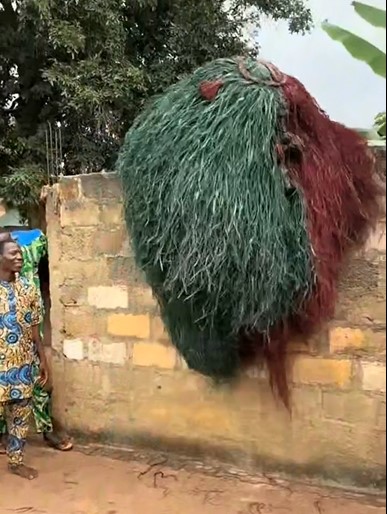
The Kumpo is particularly important because it brings together several of these elements through costume, music, performance, community participation and spiritual symbolism.
For the more curious and cultural scholars amongst us, many young Africans, for instance, the study of the Jola is a chance for us to hold true to the real about our African tribal traditions, apart from the powerful kingdoms and empires.
To save this heritage is not to reject contemporary education, technology or religious diversity. It means simply that the cultural inheritance should not be forgotten by societies in the course of change.
Conclusion
The story of the Jola people of Senegal and The Gambia is a story of cultural continuity, adaption and community identity.
From their historical settlements in Casamance and Foni to their agricultural achievements, indigenous languages, traditional spirituality and family customs, the Jola have maintained a distinctive place in the cultural history of West Africa.
You Can Also Read: The Pyramids of Giza and Mysteries of Egypt’s Greatest Ancient Wonder
They farm rice the way it has been done in the past, which shows the importance of knowledge and collaboration. In their local community their institutions reflect the importance of helping one another and their celebrations and music reflect key parts of their shared identity.
One of the more interesting symbols of this heritage is the Kumpo. Behind its extraordinary raffia appearance and animated gestures is a tradition associated with spiritual beliefs, community and cultural memory.
We think the tradition should be preserved in the face of the modern world that is gradually taking over African societies.
To me, perhaps the most important thing that Jola story taught me is that the character of a given nation is not only reflected by the numbers of its inhabitants or its former emperors’ control over their former territories. It may also be present in the language they speak, the culture they develop and the land they re-inhabit.
Remember the Jola African cultural legacy is diverse and needs to be preserved for future generations.
About the Author
Habila Ibrahim is a cultural writer and the author behind Kunzaar website, a platform that is dedicated to documenting African and world history, traditions, indigenous communities and cultural identities.
And through Kunzaar website, Habila Ibrahim seeks to bring the stories of different African and the world communities closer to readers by exploring their origins, historical experiences, traditional beliefs, festivals, languages and ways of life.
These articles are written by him based on the community he documented and his intent is that all communities should have a story to tell and that his writings can be left for future generation as a venture to learn about the culture of our great ancestor, to be enlightened and use such knowledge for safe-keeping.
Sources and References
The article is based on published historical research, academic studies and cultural heritage documentation. These sources are useful for checking the historical background and understanding the Kumpo tradition.
Minority Rights Group International (2017) – World Directory of Minorities and Indigenous Peoples: Diola (Jola) of Senegal. Provides information about Jola settlement, history, agriculture, religion and contemporary challenges.
Olga F. Linares – Power, Prayer and Production: The Jola of Casamance, Senegal. A Cambridge University Press study examining Jola agriculture, rice cultivation, religion, labour and social organisation.
Ferdinand de Jong (1999) – Trajectories of a Mask Performance: The Case of the Senegalese Kumpo. A scholarly account of the Kumpo mask and the evolution of its role in society.
Aldi Gauci (2025) – Jola Kumpo masquerade as the More-than-Human. Examines the spiritual and environmental importance of the Kumpo.
The Gambia – Intangible Cultural Heritage Documentation. Provides information about the Kumpo masquerade, its raffia costume, materials and performance practices.
Jordi Tomàs (2006) – The Traditional Authorities Cross the Colonial Border: Opposing Views on the Role of the Religious Leaders of the Jola Huluf and Ajamaat of the Lower Casamance (1886–1909). Discusses Jola communities across modern national boundaries.
Please Note: This is a secondary-source cultural piece not an ethnographic, in-the-field account, and, if this story is to be published, it would be worth getting additional feedback from Jola elders or cultural custodians, especially about the significance of the Kumpo, local marriage practices and rites of initiation, although these vary among communities.