
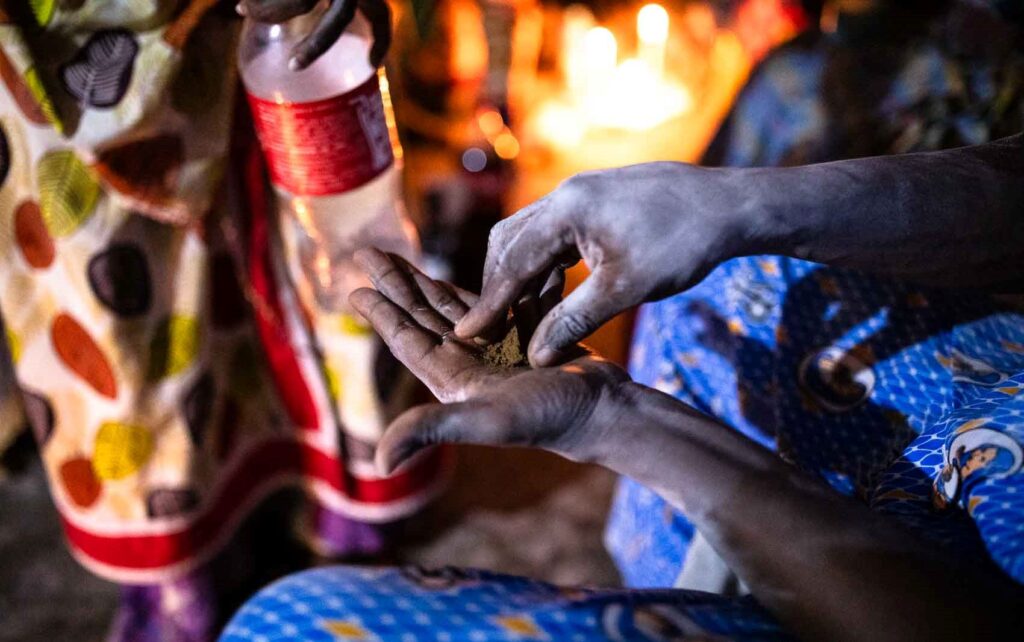
By Habila Ibrahim, Abuja | Last Updated on August 30, 2026.
Introduction to Bwiti in Cameroon: A Journey into the Spiritual World of the Fang
Every culture has its stories that are not readily understood by people outside that culture. Some are told through music and dance, others through festivals, food, clothing, family traditions or ancient stories passed from one generation to another. But there are also traditions that take people much deeper into questions of life, spirituality, ancestry and identity.
And that is what makes the tradition of the Bwiti so fascinating.
In this cultural journey we visit the forest regions of Central Africa to learn of Bwiti among the Fang people, focusing on Fang communities connected with the southern Cameroon and the larger cultural area reaching into Gabon and Equatorial Guinea.
Bwiti is an initiatory spiritual tradition associated strongly with the use of the sacred iboga plant, ancestral beliefs, ritual music, teachings and ceremonies. This practice is well documented in the case of the Fang of Gabon but is known in southern Cameroon as well.
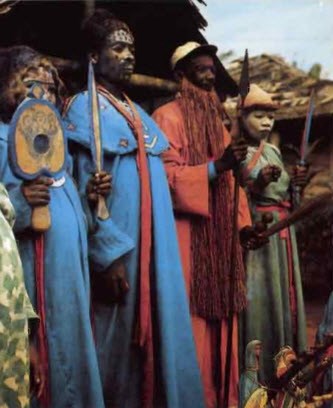
For those who practice Bwiti it is not just a ceremony to attend. It is a serious spiritual and cultural experience connected with identity, ancestral knowledge, moral guidance and personal transformation.
The more I researched Bwiti, the clearer it became to me that this could not be just some weird African ritual. To the people who practice it, it carries meaning that reaches into their understanding of life, family, ancestors, community and the unseen world.
So, let us have a quick in depth about this fabulous practice.
Where is Bwiti Practiced among the Fang?
The Fang people live across parts of Cameroon, Gabon and Equatorial Guinea, with their historical and cultural connections extending across the borders of these modern countries.
This means that since these borders were much younger than the traditional practices they separated, these would not necessarily cease at the national border.
Available studies of iboga and Bwiti document occurrence amongst communities of the Fang of southern Cameroon in the broader equatorial forest area.
Nevertheless, it is good to be aware of the fact that Gabon is the country associated most with Bwiti in the current literature. It is an ancient practice there with a robust documented history, even by the Fang and various other cultural groups there.
That is why saying Bwiti is just Cameroonian would be inaccurate. Better, said Bwiti is part of a central African spiritual history and culture that runs throughout this area, not just in Cameroonian space.
Places Associated With Bwiti Ceremonies
Traditional ceremonies may take place in culturally significant spaces such as:
Ceremonial or temple houses
Community spaces prepared for ritual activities
Forest environments
Places connected with ancestral traditions
The physical environment is important because the forest itself has traditionally played a major role in the spiritual and cultural lives of many peoples of the equatorial region.
Also Read: The Fang People: History, Culture, Festivals, Food, Beliefs & Traditions
Nature can’t be a background for the cultures. It can be part of the spiritual world and a source of plants, knowledge, stories and ancestral memory.
When are Bwiti ceremonies Held?
One interesting thing about Bwiti is that it does not function like a modern public festival with one particular date every year.
No special “Bwiti Day”. There are no days where all Bwitists meet.
Instead, ceremonies are connected to particular spiritual, social and initiatory circumstances. Different Bwiti communities and branches may also have their own practices.
Ceremonial activities can include: Initiation, Spiritual instruction
Healing-related practices, Ancestral remembrance, Community gatherings and Responses to individual spiritual needs.
Some important ceremonies take place at night and may continue for many hours. Music, song, dancing, and other ceremonies were parts of certain ritual vigils, according to some ethnographical studies.
The fact it happens at nighttime adds to the ritual atmosphere too. It’s obvious to all the participants that it isn’t really a “party” or get-to-gether, where entertainment, fun, and enjoyment is really the purpose or the point of it all.
Understanding Bwiti initiation
Initiation is one of the most important aspects of Bwiti.
It is not just another ceremony where some one gets a title, or enters a social club. Historically, and conventionally, any initiation is considered an essential spiritual and Personal, Human transformation (journey).
The initiate is introduced to teachings, symbols and experiences that are understood within the community’s spiritual worldview.
Different branches of Bwiti have developed different practices, so it is important not to assume that every Fang community follows exactly the same procedure.
There remain, nonetheless, a number of the prominent themes which reoccur again and again in accounts describing Bwiti Fang.
1. Preparation Before Initiation
The amount of preparation required is because initiation itself is seen a much serious business.
Requirements for initiation may (depending upon community and branch) include:
– Instruction from knowledgeable individuals or Spiritual leaders
– Time of reflection or self preparation
– Observance of specific fasts or dietary restrictions
– Attending introductory rites and ceremonies
The point is not to prepare the body. It is also intended to prepare the mind and spirit for what the initiate is about to experience.
For someone to journey into the teachings of Bwiti, it may mean to die an older aspect of a life in order to be born in a higher step of spiritual awareness.
2.The Importance of Iboga
The one that people know best in this group is iboga, Tabernanthe iboga.
The iboga is from Central Africa and has always been used in spiritual healing rituals. It is particularly important in Bwiti ceremonies. Research describes its use in connection with initiation and visionary experiences.
Bwiti has the understanding of the plant that iboga is not just an ordinary plant.
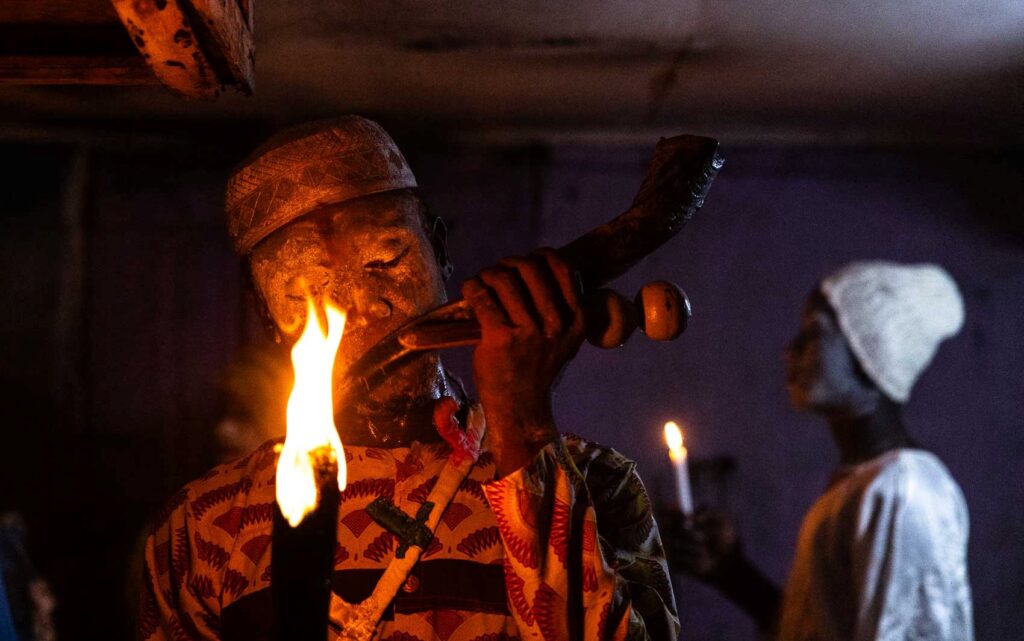
It is considered sacred and is thought to be associated with spiritual knowledge and with contacts with the other world.
It is however crucial in this to differentiate cultural belief from scientific description. But researchers and therapists have approached iboga with different terminology describing the plant’ terms of physiology, and treating subjective iboga visions as spiritual experiences.
Using it like this, allows us to talk about Bwiti without imposing a religious doctrine as fact.
How does Bwiti Connect Participants with their Ancestors?
But here is one of the most striking of all Bwiti aspects.
Among Fang practitioners, the relationship between the living and the ancestors is an important part of the spiritual worldview.
The ceremony brings together several elements: Sacred plant traditions, Music, Dance, Chanting, Symbolism, Spiritual instruction, Ancestral beliefs and Community participation.
In combination these make it an impressive ceremonial experience.
But let us consider some of them in more detail.
A. Iboga and the Spiritual Experience
In Bwiti traditions, it is believed that iboga is a way in which an initiate can experience another level of consciousness.
Historical and ethnographic narratives tell about visionary experiences in which visions of spirits or ancestors may be granted to the candidate. Traditionally these experiences have been interpreted by the religious frame of the community as journeys connected to the world of the ancestors.
Such experience can be quite instructive as far as the practitioner is concerned.
They may be interpreted as revelations concerning: Family, Ancestry, Personal character, Life’s responsibilities, Spiritual direction and The relationship between the living and the dead.
The important point is that the experience is given meaning through Fang and Bwiti teachings.
B. Music, Drumming, Singing and Dance
Bwiti is not only about the initiate and the spiritual experience.
Music plays a role in many occasions/rites and ceremonies.
Traditionally night time rituals were accompanied with songs accompanied by musical instruments. Some branches are linked to instruments such as the ngombi harp and percussion and other ritual instruments.
These recurring chants and melodies add a ritualistic feeling, to what would generally be a rather non-descript day.
Music also has wisdom.
Songs will also serve the following: Stories, Spiritual teachings, Historical memories, Moral lessons and Community identity.
This is an area in which past practices of traditional ceremonies are particularly valuable. That a song may transmit messages from one generation to the next which would otherwise be lost.
C. The ancestral role
In order for us to understand Bwiti fully, we need to understand the significance of ancestors.
In many African traditional belief systems, ancestors are not simply remembered as people who lived long ago. They may continue to be regarded as part of the spiritual community and as sources of wisdom, protection or moral authority.
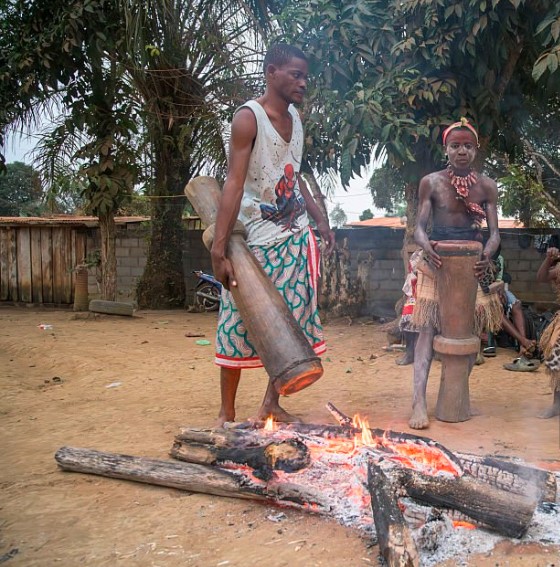
Widespread in fang traditions: veneration of ancestors. Many academics describe the Fang Bwiti as a tradition that did indeed reform and reinvent earlier Fang religious themes and practices to emerge as an autonomous syncretic phenomenon.
This would serve Bwiti the one strong link to family history.
Individual is not seen as an isolated person.
The person is one of many in a large hierarchy of past ancestors, grandparents, parents and great-grand children.
D. Symbolic Death and Rebirth
A further important concept connected to initiation, is that of death and re-birth.
It doesn’t have to be in death.
It is not an actual death, but a death of the old life in the spiritual sense and a rebirth into a transformed individual.
The new awareness may see the experience as a journey through which; Old self -> is transformed into -> new self.
This concept provides initiation with a very significant value.
After passing through the experience, the initiate is expected to return to ordinary life with a deeper understanding of responsibility, identity and spirituality.
E.The Role of the Nganga
The nganga is an important religious specialist in Bwiti-related traditions.
A healer, diviner or specialist could also be a so-called priestess for those in some cultures, but the specific function will certainly depend on their society and ritual system.
The BWITI ceremony guides with the experienced leader to conduct you safely through the ritual.
Such duties can include: Taking care of first babies, Leading rituals, Explaining events, Guarding ritual ways and Giving spiritual advice.
This leadership is all the more pertinent in that Bwiti is no mere solitary journey.
The teaching is passed to people who themselves have been trained in the tradition.
F. The Community’s Role
Despite the very individual nature of the experience of initiation, Bwiti is also a communal matter.
The culture explains to the initiate that that’s what has occurred.
Experienced and elder members can use this wisdom to bridge personal experience with the teachings of existing traditions.
It is precisely this communial aspect of culture which is so important as traditions carry on only through the transfer of knowledge from generation to generation.
With respect, in this context Bwiti is not about a solitary spiritual adventure. Also about the retention of an community’s memories.
G. Sacred Places and Ritual Objects
The physical environment also contributes to the ceremony.
Bwiti traditions are associated with ceremonial houses and ritual spaces where music, teaching and initiation can take place.
It doesn’t mean that these traditional objects would be used as decoration too. In many African ritual traditions, objects can have symbolic, ancestral or spiritual significance.
Research on Bwiti material culture describes ceremonial houses, musical instruments, carved figures and other ritual objects as important parts of the wider religious system.
Others might pass these things off as works of art but for them it meant more.
However, for the practitioners there is an extra meaning.
Bwiti and Christianity
One of the most interesting developments in the history of Fang Bwiti is its relationship with Christianity.
It was in the context of this era of European colonial expansion that the Fang people came in contact with Christianity, which many groups on the Fang also converted to. At the same time, Fang Bwiti also emerged along a similar pathway including elements of Christian thought and symbols.
Scholars therefore often describe Fang Bwiti as a syncretic tradition.
In other words, in general terms, syncretism implies that features from different religious, cultural traditions are assimilated or reinterpreted in a new religious tradition.
This is what has made Fang Bwiti so fascinating culturally.
Which is to say something to us, that Cultures do not have to be set in stone.
They are able to gain outside input into some of these important sections of the old self.
Why Bwiti is Important to Fang Cultural Identity
It is important because of the traditions but also because of this knowledge (that Bwiti gives).
It can help to maintain:
1. Ancestral Knowledge
Oral transmission is the transfer of stories, knowledge and teachings from elders to the youth.
2. Community Identity
Shared ceremonies (aid in) maintaining the bonds between the members of the community,
3. Oral Tradition
Songs, chants and spoken teachings protect the knowledge.
4.Moral Instruction
Initiation can communicate ideas about responsibility, family and personal conduct.
5. Spiritual Identity
For followers of Bwiti, it helps make sense of the individual’s relationship with spirits and ancestors, as a whole system.
Bwiti Is a Living Tradition
One mistake people sometimes make when discussing African traditional religions is to describe them as if they belong only to the distant past.
But Bwiti defies that thought.
It has continued to exist and evolve, even as Central African societies have experienced Christianity, modernization, urbanization, formal education and other social changes.
Research on Fang Bwiti has recorded both adaptation and the relationship with Christianity and demonstrated that the tradition has changed over time and has not just remained frozen in its historical form.
You Can Also Read: Balinese People: History, Culture, Origin, and Marriage Traditions
This is a reminder that culture is living.
Even with alteration it is possible to avoid losing entirely the substance of the custom.
Important Things to Remember About Bwiti
As an initiatory tradition Bwiti is a religion that must be respected if one does not practice it.
There are a number of things that should be remembered:
– Bwiti is not to be seen simply in entertainment or recreational terms.
– Some carriages and teachings are private.
– Not all parts of initiation are intended for observation by the public.
– Practices may vary in different communities and sections of the faith.
– Cultural beliefs are to be understood in the context of that culture.
The drug Iboga has powerful psychoactive effects and can also be very dangerous; it must not be treated as if it was an everyday substance just to test it out based on an internet article.
Visitors and researchers must respect the authority of the communities concerning what can be taken photos, videos or explained publicly to them.
The safest and most respectful methods by which to learn about Bwiti is from reputable cultural and academic sources and, when suitable, with the consent of practitioners or scholars, by engaging with the culture.
Bwiti Beyond the Borders of Cameroon
Even though this article will refer to theFang of Cameroon specifically, Bwiti could not be properly explained withoutrefering to its history elsewhere in Central Africa.
Bwiti is a practice of great historic importance to the culture of Gabon and is practiced by many peoples there. It was adopted and adapted by the Fang and developed into distinctive Fang forms.
Migration of the tradtion between the ethnic and national borders of Cook Island society provides an ideal illustration of culture’s travel.
– People migrate.
– Families move.
– Communities interact.
– Ideas are exchanged.
– Religious forms are accepted, modified and assigned new significance.
– This can be seen historically in Bwiti.
What Bwiti Teaches us About African Culture
That for me is one of the most incredible lessons that comes out of studying Bwiti, you simply can not equate African culture with brightly colored clothes, happy dances or festival practices.
There are deeper levels.
It looks like there’s a knowledge-based system around.
There are spiritual philosophies.
There are oral histories.
There are relations between human and the environment.
There are ideas about life, death, family and ancestry that have survived generations.
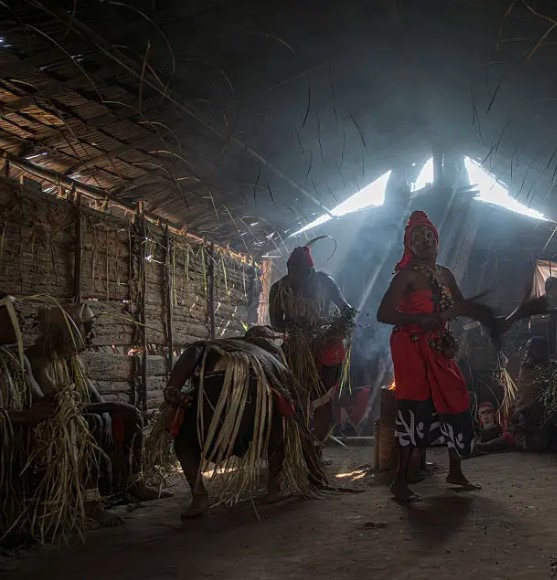
Bwiti is the other example for this richer cultural inheritance.
And it’s another reminder to remember that cultures of Africa are not monolithic. What is practiced among the Fang may be different from what is practiced among another Central African people.
One of those diverse elements we think should be celebrated not disregarded.
Conclusion: A Tradition Between the Ancestors and the Living
The story of Bwiti among the Fang people is a story of spirituality, identity, ancestry and cultural survival.
Contemporary knowledge sources offer the fullest descriptions of Bwiti as a religion within the nation-state of Gabon although it is practiced by Fang groups in southern Cameroon, showing it to be a form of culture that transcends national borders.
At the centre of the tradition is a powerful understanding of the relationship between the individual, the community and the ancestral world.
Through initiation, music, storytelling, spiritual instruction and the traditional use of iboga, Bwiti provides its followers with a framework through which they understand important questions about life and identity.
But all the same, culture perhaps not only reserved for museums.
– It lives in people.
It has lived long enough to get into songs.
– It lives in stories.
– The life is present in the ceremony.
– It makes life in the hearts of old people and the wonder of future generations.
And as long as we continue to carry our cultures forward, to find ourselves there and change it and transmit it, it can continue to be part of the larger human human being saga.
As I journey on through this cultural landscape of Kunzaar, I am not trying to judge the beliefs of another people, nor to elevate one culture above another. The only job here is to learn, to understand, to tell them their stories to you, respectfully.
Read: DIY Graphic Design for Small Business Branding (Step-by-Step Guide)
Culture is what offers us an incentive to understand each other; and what offers a path toward unity among us, with few exceptions stronger than the one toward mutual understanding.
About the Author
Habila Ibrahim is a Nigerian cultural writer and blogger with a strong interest in African history, traditions, indigenous communities and the cultural practices that make societies unique.
Habila tempers cultural knowledge with practical experience in his writing to demystify and simplify different cultures to a broader reading audience across the globe, especially Africa and beyond.
His attitude comes down to this: find out about someone else’s culture before you are critical of it.
And this is just another stop in that ongoing cultural road trip.
Sources and Note
This article was rewritten and expanded from the original Kunzaar write-up on “Bwiti Ceremony Among the Fang People of Cameroon”, while checking the historical and cultural details against available academic and research materials.
Key references consulted include:
1. Jacques Binet, “Drugs and Mysticism: The Bwiti Cult of the Fang,” Diogenes, Cambridge University Press. This work provides important historical and ethnographic discussion of Fang Bwiti and the relationship between the Fang, Bwiti and Christianity.
2 Giorgio Samorini, studies on the iboga cults and Bwiti. These recent academic studies examine the historical development, ritual practices and geographical spread of iboga-related traditions, including Fang Bwiti.
3. André Mary, Le Défi du syncrétisme: Le travail symbolique de la religion d’Eboga. This important study examines Fang Bwiti as a syncretic religious tradition shaped by the interaction of Bwiti, Fang cultural traditions and Christianity.
4.Research on Tabernanthe iboga. Studies and reports on iboga document its traditional use and its presence among Fang communities in Cameroon, Gabon and Equatorial Guinea.
5. African Art Archive – Bwiti cultural overview. This source provides additional information about ceremonial practices, ritual spaces, musical instruments and the material culture associated with Bwiti.
A Personal Note from the Author
I have written this article with one important principle in mind: when we write about another people’s culture, we should do so with respect.
We all share in many cultural practices, not to say beliefs, that just dont appear particularly odd, foreign or downright funny to all those individuals on a similar playingfield – to many outside their society such as ourselves. That does not make them meaningless to the people who inherited them.
The purpose of cultural writing should therefore not be to mock, sensationalize or misrepresent.
It ought to be to learn.
It should be to ask questions.
And what is crucially it should foster a sense of amazement at the sheer diversity of human history.
It is the spirit of this cultural quest of Kunzaar. — By Habila Ibrahim