
By Habila Ibrahim, Abuja | Last Updated on August 4, 2026.
Introduction
Many people didn’t know that we have other tribes in South Africa apart from Zulu.
When many people think about South Africa, the Zulu are often the first ethnic group that comes to mind. Incidentally Africa holds such a treasure of different communities of all shapes and sizes. I think we are all to be guided by such stories one day. These include the distinctive communities of Ndebele people whose attractive and traditionally colored houses and patterns with complex designs along with their distinctive culture are interesting travelers, artists and Historians for years and years.
The first time I saw pictures of the traditional Ndebele houses I honestly must confess that I really thought that professional painters must have been involved. They were so filled with vibrant geometric designs on every wall you encountered and with every colour painted upon each aspect, they screamed stories and told legends of a rich culture born of dignity and pride, this rich culture that spoke of people who had come to the realization of a much bigger narrative with only their vibrant paintings and colors as a guide!
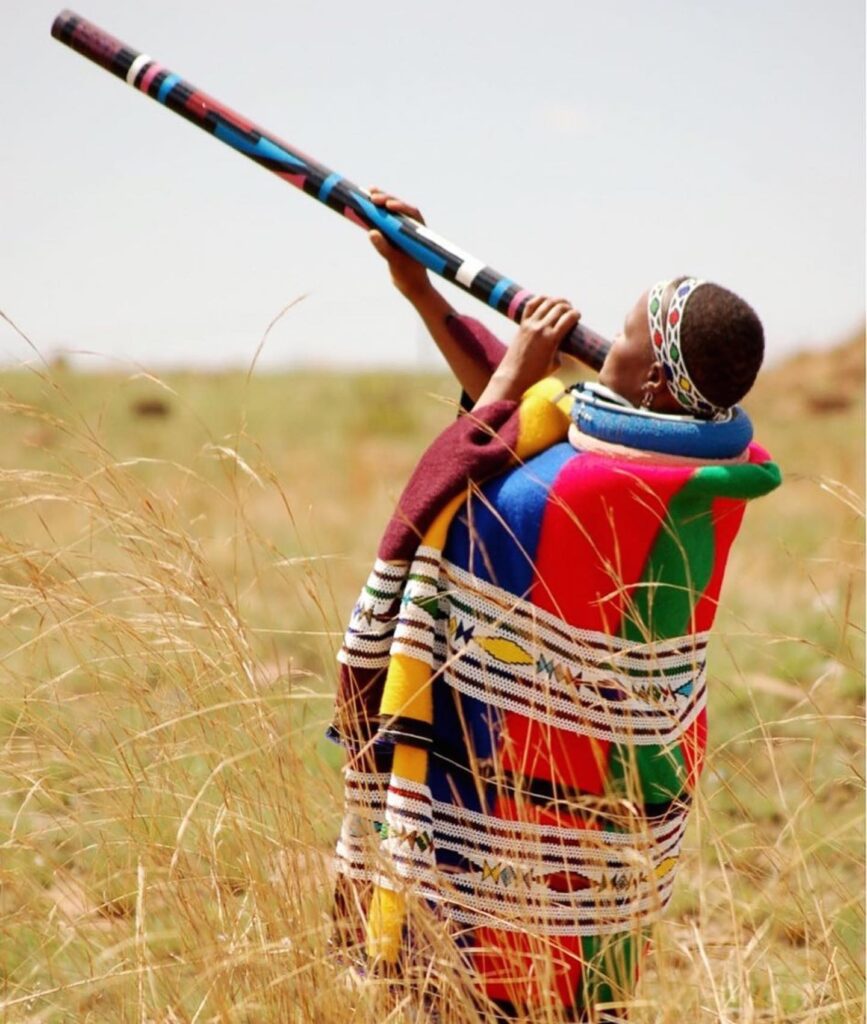
These are the proud Nguni people whose origins are in current day southern African states from as far north as Zimbabwe, to what is know South Africa. They carry rich artistic heritage but this only captures part of the reality, since these also hold value such as family, honour for their progenitors and survival skills from hundreds of years of displacement, war and foreign imposition on their land.
Also Read: 7 Cultural Practices That Still Exist in Africa Today
In this article, I’ll take you through the history, origin, traditions, food, religion, festivals, marriage customs, and everyday life of the Ndebele people. Whatever you are seeking by way of studying about African culture, if it’s merely about understanding among the continent’s very peculiar communities by way of their unique seem and form then I hope you get pleasure from this voyage into Ndebele tradition.
History of the Ndebele People
The history of the Ndebele people is closely connected to the powerful Zulu kingdom of the 19th century.
The Breakaway from the Zulu Kingdom
In the early 1800s, Ndebele military leader named Mzilikazi kaMashobane served under the famous Zulu king known as Shaka Zulu. Due to political tensions and conflicts, Mzilikazi broke away from Shaka and led his followers northward during the period known as the Mfecane (a time of widespread warfare and migration in Southern Africa).
Mzilikazi and his followers traveled through present-day South Africa before settling in what is now southwestern Zimbabwe. This is how the Ndebele people found their way and region till this present-day.
Formation of the Ndebele Kingdom
After years of migration, the Ndebele established a strong kingdom in the region of modern-day Zimbabwe, with their capital near present-day Bulawayo.
The kingdom became one of the most powerful states in the region until British colonial forces conquered it in the late 19th century during conflicts with the British South Africa Company.
Despite colonial rule, the Ndebele people maintained their language, traditions, and identity.
Origin of the Ndebele People
The Ndebele people are part of the larger Nguni ethnic group of Southern Africa. Linguistically and culturally, they share roots with the Zulu, Xhosa, and Swazi peoples especially with the Zulu because they used to joint military forces together to conquered an entire region.
There are two main Ndebele groups:
Northern Ndebele (Zimbabwe Ndebele) – Mainly used in Zimbabwe.
Southern Ndebele (South African Ndebele) – indigenous to the Transvaal area of South Africa.
In spite of our historic affiliation, as a consequence of location together with colonialism, a few variations in the traditions manifest between united states of america.
The Northern Ndebele speak isiNdebele, which is closely related to Zulu. The Southern Ndebele speak a different dialect also called isiNdebele but distinct from the Zimbabwean variety.
Countries Where the Ndebele People Are Found
The Ndebele people are mainly located in:
Zimbabwe (Matabeleland region)
The Mpumalanga (South Africa) and Gauteng (South Africa) provinces
In Zimbabwe, they are the second-largest ethnic group after the Shona. They have a name and identity as an ethnic group. In South Africa, they are a people with a well known artistic personality.
Culture and Traditions of the Ndebele People
By far one of the most visually arresting cultures anywhere in Africa, the Ndbele have made an iconic contribution to South African art and design.
Ndebele House Painting
Maybe the highlight of the Ndebele culture is the colourful geometric wall-paintings.
Ndebele women are known for adorning the walls of their homes with bold colors including blue, yellow, white, red and green. Not surprisingly, the vibrant designs have underlying symbolic meanings, as well, signifying issues of belonging, rank, communication as well as acts of defiance in colonial South Africa.
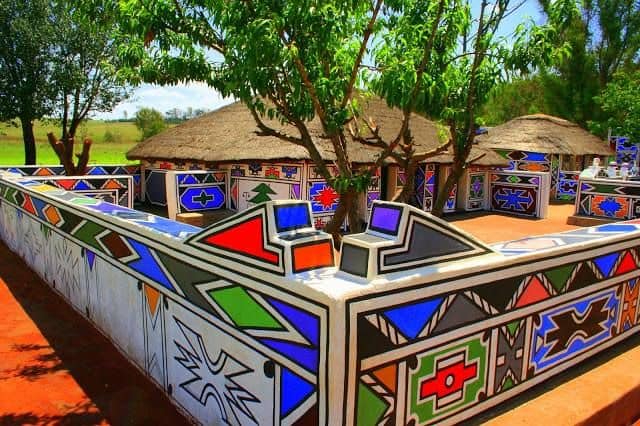
Designs – This art is world recognized and inspired the art and fashion across the countries.
Beadwork and Clothing
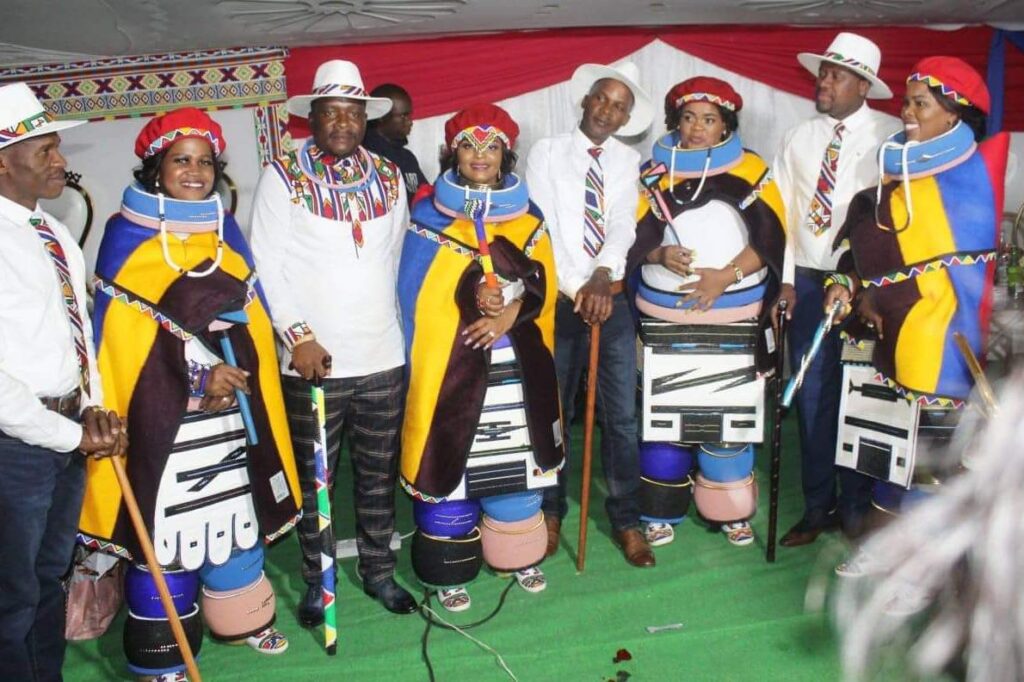
Beadwork is central to Ndebele identity. Married women are always wearing heavy necklaces, Aprons and headband indicating marriatl, that mean wearing beads to distinguish the position of the family.
The married woman can be distinguished by her many heavy neck rings of brass and copper, and by her blanket woven of various sized beads.
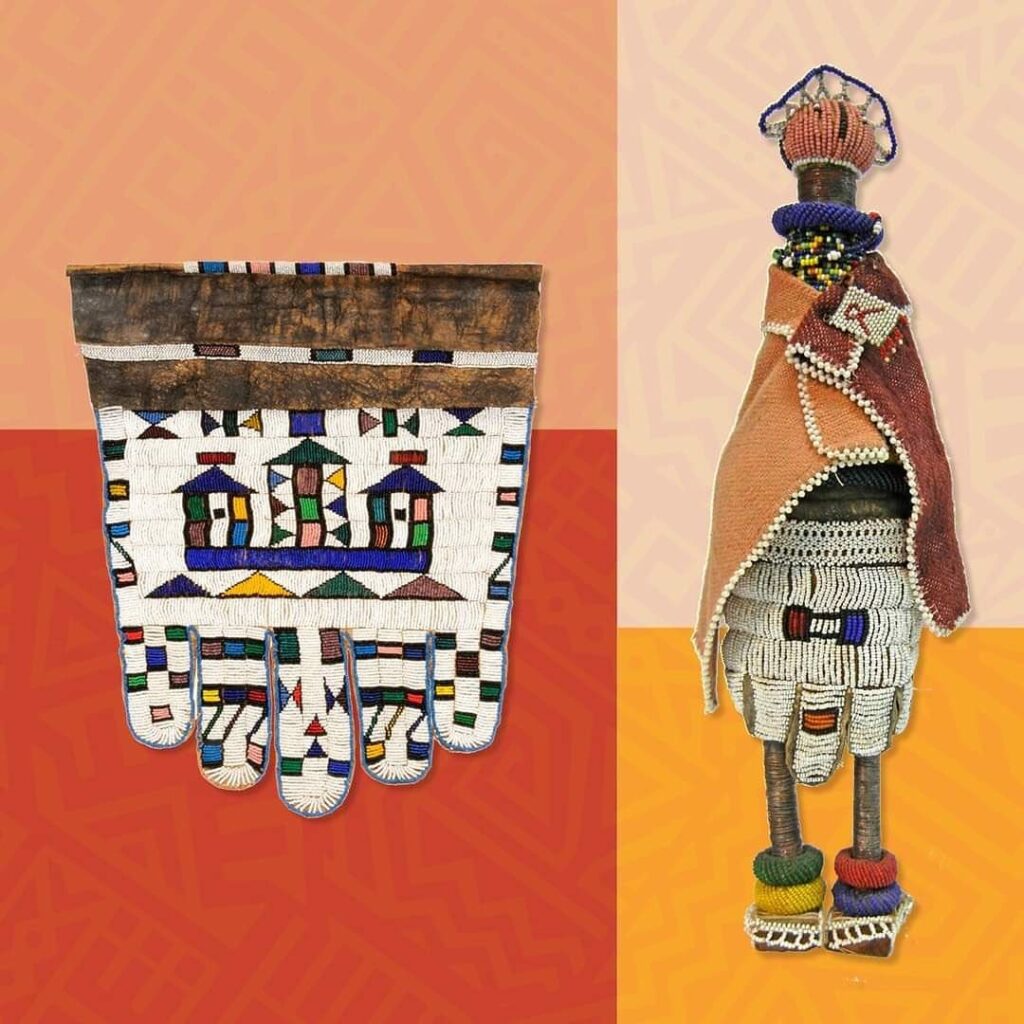
Back then men just wearing animal skin, wielding shield and also using spears. That the reflection about the heritage as warrior.
Food of the Ndebele People
Traditional Ndebele food is based on agriculture and livestock.
Staple Foods are: Maize (used to prepare sadza or pap), Millet and sorghum, Beans, Pumpkins and Leafy vegetables.
Sadza, a thick maize porridge, is the main dish and is eaten with meat or vegetable stew.
Meat and Livestock
Cattle mean so much to the Ndebele. Beef is also very frequently eaten during ceremony and celebrations. Goats, chickens.
You Can Also Read: The Shona People
Traditional is and has always been milk & sour milk.
The tradition says Food is one of the integral parts of every ritual and festivity including Marriage etc.
Religion of the Ndebele People
Traditionally, the Ndebele practiced African Traditional Religion.
Traditional Beliefs
There is a creator to whom they pray in worship, who they call Unkulunkulu, and they worship the spirits of their ancestors too, who communicate between earth and heaven or, of course heaven and earth and every thing that exists that makes up existence.
Religious leaders use rites and offerings as well as prayers and dances to venerate their deceased ones.
Christianity
Today, a large part of Ndebele population has adopted Christianity because many colonists took some Ndebele through missionaries to the churches during the days of the British as part of colonizing mission that they did.
Festivals of the Ndebele People
Festivals are central to Ndebele cultural identity. It seems like the occasion is perfect for unity and the remembering and of the happy occasions.
Umhlanga (Reed Dance)
Today most widely observedby among the Swazipeople, some Ndbele people do still engage in reed dancing ceremonies. This cantered festival which is used to mark purity, womanhood and national pride.
Inxwala Ceremony
The Inxwala or new era Kingship Dance: Kingship ritual performed to symbolize new year, unification with offerings and ritual songs/dances. It is about gifts, dance and pledge of allegience to the king.
Cultural Days and Heritage Celebrations
In South Africa, the Ndebele have cultural heritage events demonstratingTraditional drumming and singing dance; and Beadwork and traditional paint design exhibitions.
Everything you Need to know about Ndebele Festivals
Here are key facts about Ndebele festivals:
1. Purpose
Festivals bond and heritage It doesn’t hurt communities more than anything than destroying our shared values and heritage.
2. Timestamp
So in some cases we can observe connection of traditional ceremonies with growing periods of some agricultural activities for example.harvest season.
3. Dress Code
Participants put on the traditional regalia, beaded dress and bright colored blankets.
4.Role of Women
Women are largely responsible for prep, dancing and decoration.
5. Music and Dance
There is rhythm and music through drumming and chanting, and group synchronized dances form an important feature.
6. Spiritual Aspect
Some festivals include ancestral rituals and offerings.
7. Modern Influence
Today many festivals do that to attract tourists and education of cultural activities also.
Marriage Customs of the Ndebele People
Ndebele Marriage is held in high esteem.
Lobola (Bride Price)
The groom’s family pays lobola, usually in cattle, to the bride’s family. This represented love, celebration, family’s unions.
Traditional Wedding Ceremony
These include; Negotiation of bride price, Sacrifice ceremony (Kula ng’ombe), Traditional dances,Blessing from the elders.
Role of Women in Marriage
She may move into the groom’s household after her wedding and might sport unique Married attire in special occasions.
Marriage is not seen as aunion between two individuals, but as a between two families and even their forefathers.
Read: Peruvian Culture: Traditional Attire and Festivals
These days many of them live in the city of Harare in Zimbabwe and other towns and cities such as in South Africa, such as Johannesburg, yet remain able to continue their Ndebele traditions.
Its distinctive and attractive visual designs and colours have had a global impact on fashion, buildings and interiors design. Their geometric patterns appear in galleries and international exhibitions.
Notwithstanding the colonialism and political instability that have been part of its history the Ndebele maintain that its heritage is its own to be very proud of.
Conclusion
A truly incredible ethnic community – Ndebele people – has a vibrant culture with a warlike heritage, spirit, art and culture that carries weight from generations back – the Ndebele have a way about their identity; the story of their exodus under Mzilikazi to the painting style of their humble homes with intricate beading has always carried weight.
To learn about the Ndebele people is to be reminded that culture is more than simply clothing, art or traditional ceremonies. It is a live identity language being reproduced from generations to generations through family stories language and so on.
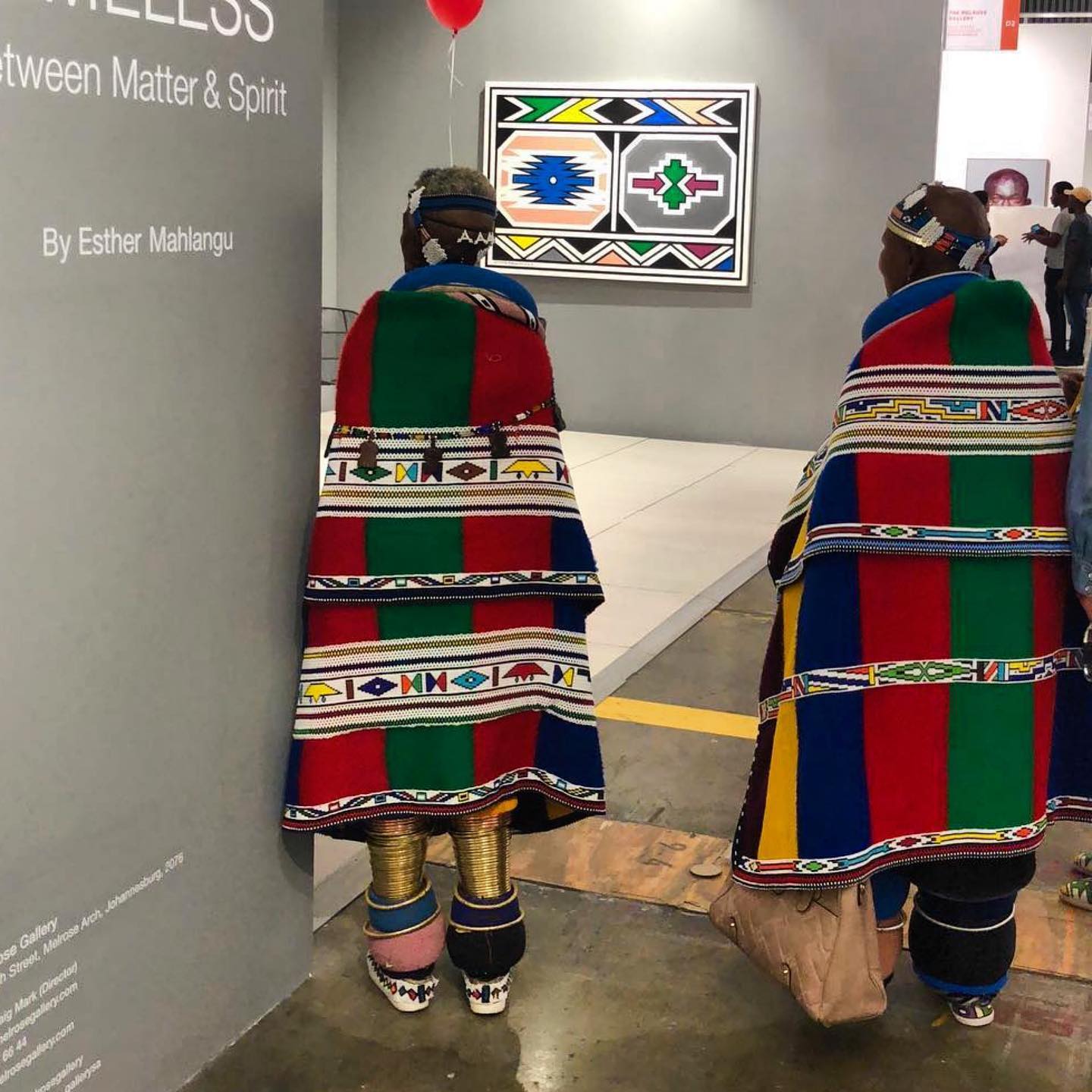
While a lot of Ndebele now lives in modern cities and adopting modern ways of life, they still cherish all their tradition which define who are, there are lots of people who gets inspired by Ndebele homes color painting, beadwork, cloths, festivals and the love they have towards family and there ancestor.
On a personal note, there is an awesome amount of beauty and ingenuity I find inspiring within the Ndebele culture in their way of how they have, against the odds, blended the changing ways of the globalised world yet maintained their roots with their traditional values. They show us history does not always go and vanish like some sort of antique-it may be revised.
I really hope this was the most exciting article, a lesson, a chance to learn about one of the incredible peoples of Southern Africa and you found the most interesting thing about one of the peoples. Feel and if you liked this I also hope, you read about any other of the many peoples I explore here on the Kunzaar; all, like this one, the Ndebele people, have something very interesting and worth-while sharing a special untold story. After all, each and every community of the world have their own legend to be narrated.
Hope you have learned that another tribe exist in South Africa. And also hope that this post is helpful? Keep visiting our blog for this and many more.
About the Author
By Habila Ibrahim Cultural Writer/Researcher Founder, Kunzaar My journey with culture began almost naturally, a simple question about how diverse communities and groups interact, celebrate and teach their children. I have chosen these as areas of my platform and my own research with Kunzaar to share and learn around the world.
I write to make culture accessible and understandable for the students and scholars alike, the traveler and history buffs; to put the complicated history to work. Every culture should have a narrative, and every narrative makes one know one another a bit more.”
I want to help preserve those stories found in different cultures, and through my extensive research and simple story-telling, to make it easily accessible to people – so as to inspire them and enrich them into how diverse and lovely societies could be, so that they can explore the past.
I’m glad you’ve invested your precious time in my article and I hope you’ve come away feeling you’ve learned something today about our amazing Ndebele tribe. There is so much more to discover and experience on our site here at Kunzaar – the land of stories, the home of culture.
Sources and Research
The article is based on historic articles, cultural research, learning material, study material done on South African and Zimbabwean Ndebele people etcetera and information carefully checked across different sources, to have an overview that’s not too much but easy to follow and respected towards the culture the community and individual are preserving.
Other background info sourced from published historic timelines and research material on cultures in the Southern Africa part of the country/countries. (South African History Online, South African History Archive (SAHA) and Interviews with Ndebele elders (2023))