
Last updated on June 11, 2026.
Introduction
Culture, no doubt about that has always been a defining part of human identity, shaping the way people live, communicate, and interact with one another. For generations, traditions, customs, languages, and values were passed down through families and communities, preserving the unique heritage of different societies. However, the rise of digital technology, the internet, and social media has transformed the way culture is created, shared, and experienced across the world.
In today’s digital age, people can connect instantly across continents, access diverse cultural influences, and adopt new lifestyles at an unprecedented pace without restriction. While modern technology has helped preserve and promote cultural heritage, it has also introduced new challenges, including the gradual decline of some traditional practices and the blending of cultural identities. As a result, societies are constantly balancing the preservation of their cultural roots with the opportunities presented by modernization.
This article explores the relationship between modern and traditional culture, examining how cultural values, customs, and identities are evolving in the digital age and what this transformation means for future generations to come.
When Culture Meets the Cloud
No doubt, culture has always been dynamic—shaped by migration, trade, colonization, and now, technology. In the 21st century, the rise of smartphones, social media, and digital platforms has accelerated cultural evolution like never before. Many cultures have been widely spread in Facebook, WhatsApp, Instagram, Telegram, TikTok, YouTube, etc. this along has made culture to be known even with those who have never heard of the existence of such culture.
From traditional dances now going viral on YouTube, Facebook, TikTok to ancient proverbs being turned into Instagram quotes, we are witnessing the fusion of the ancestral and the algorithmic nature of culture. But how exactly is modern culture impacting traditional values, customs, and identities? Let’s break it down for more understandable form.
Traditional Culture is the Foundation of Identity
Traditional culture encompasses:
- Language and dialects
- Food, fashion, and festivals
- Oral traditions and folklore
- Family structures and rites of passage
- Religion and spirituality
These elements mention above serve as the blueprint of a people’s identity, shaping values, behaviors, and worldview.
“When an old man dies, a library burns.” – African proverb
You Can Also Read: Understanding BODMAS
But in the face of globalization and rapid tech innovation, these traditions are being challenged—and sometimes redefined. Though some tribes or language doesn’t have a standard record that someone will go for research, they only depend on the elder people in that tribe to narrate their experience. But with modernization, many histories have been recorded even not exactly as it supposed to be, but is fairly understandable.
Modern Culture: The Digital Tsunami
Without missing words, modern culture today is driven by:
- Social media trends (TikTok, Instagram, Facebook, Telegram, YouTube)
- Instant messaging and emojis replacing oral language
- Fast fashion influenced by global style
- Music fusion (Afrobeats, Amapiano, Hip Hop)
- Streaming of movies and digital storytelling
Technology has made culture more accessible and exportable like never before, but also more prone to dilution.
5 Ways Culture Is Evolving in the Digital Age
1. Language Preservation & Loss
- Apps like Duolingo are preserving endangered languages
- But emojis and slang are replacing nuanced expressions
- Indigenous languages are gaining visibility through meme culture
2. Traditional Dress Goes Digital
- Kente, Ankara, and Maasai Shuka are worn in global fashion shows
- Hashtags like #AfricanStyle and #ModernTrad are now trending online
- Young Africans remix tradition with modern cuts for weddings and music videos
3. Storytelling in 60 Seconds is Now making Wave Online
- Oral storytelling is now visual (TikTok skits, YouTube shorts)
- Folktales are becoming animations and podcast episodes
- Digital griots (online historians) preserve myths with new tools
4. Religion & Rituals in the Digital Era
- Online prayer groups and livestreamed religious services
- Traditional festivals are now global via livestream (e.g., Osun-Osogbo)
- Debate: Is virtual worship eroding or expanding spirituality?
5. Identity & Diaspora Connections
- Second-generation Africans abroad reconnect via Instagram culture pages
- TikTok challenges revive traditional dances (e.g., Atilogwu, Shaku Shaku)
- Memes and humor carry subtle lessons from culture
Digital platforms are turning young people into cultural ambassadors.
Challenges of Digital Cultural Evolution
Anything that has good side, sometimes it has its bad size. Digital culture is not an exception. While there are many positives, digital culture poses risks:
- Cultural dilution: Elements are adopted without context
- Digital divide: Elders and rural communities may be left out
- Appropriation: Cultural elements are used commercially without credit
Preserving authenticity while embracing innovation is the challenge of our time.
Balancing the Two: A Cultural Hybrid
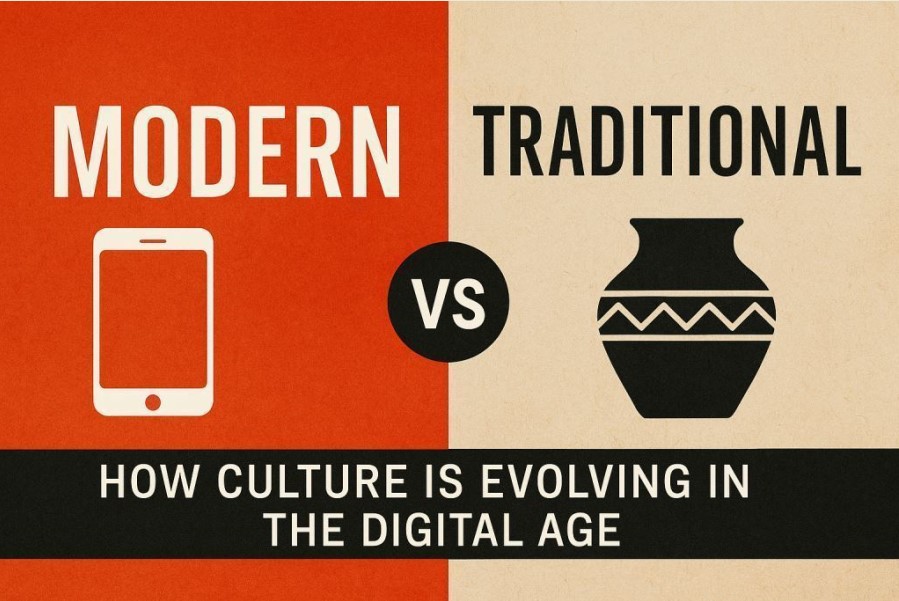
The future is not about choosing one over the other—it’s about balance as tabulated below.
| Traditional Culture | Modern Culture |
| Elders & oral transmission | Podcasts, vlogs & blogs |
| Ritual dance & attire | Viral dance trends |
| Proverbs & folktales | Digital storytelling, animations |
| Community festivals | Global virtual events |
Culture Doesn’t Die, It Adapts
Though some cultures are fading due to modernization or adaptation to other culture. Culture isn’t static. It’s a river—shaped by every generation it flows through. Thank God for digitalization. What we’re witnessing in the digital age is not the death of tradition, but the rebirth of culture in new forms.
You Can Also Read: The Tuareg Tribe And Also The Desert Nomads of the Sahara
The main key is ensuring that modern tools carry ancient wisdom, not erase it.
“Our culture is not a costume. It’s a code.” – Habila Ibrahim, Kunzaar
Conclusion
The digital age has brought significant changes to the way culture is practiced, shared, and preserved. While modern technology has introduced new forms of communication, entertainment, and social interaction, traditional cultural values and customs continue to play an important role in shaping people’s identities and sense of belonging in years to come. Rather than completely replacing tradition, modernization has created opportunities for cultures to adapt and remain relevant in a rapidly changing world through the use of social media.
As societies continue to embrace technological advancements, it is essential to strike a balance between innovation and cultural preservation. Communities, families, and institutions must work together to ensure that languages, customs, festivals, and traditional knowledge are passed on to future generations. By embracing both modern and traditional elements, people can enjoy the benefits of the digital age while maintaining a strong connection to their cultural heritage.
Ultimately, culture is not static—it evolves with time, and its strength lies in its ability to adapt without losing its core values and identity. Let’s continue to use the social media to promote our cultures so that we can preserve it to the next generations to come without any threat of extinction.
Take Action Today
How has technology changed your relationship with your culture? You can share and also comment below so as to keep our culture heritage alive! Let built ties through cultures. Also Visit our YouTube Channel: KunzaarChannelsTV through @kunzaarchannelstv to watch the best of cultural heritage. Tag us using #DigitalTradition for a chance to be featured!
Thanks so much
Very proud to be a student at the Faculty of Mathematics and Computer Science, University of M’sila.
Very proud to be a student at
Very proud to be a student at
The point about using digital tools for language preservation in Africa stood out to me, especially as younger people shift more of their storytelling online. For anyone exploring the video side of that shift, Kavel’s look at free AI video generators in 2026 Best Free AI Video Generators in 2026 (Real Limits Tested) is a useful companion resource.
I appreciated the point about digital storytelling helping preserve African languages and oral traditions rather than replacing them. Tools for quick visual formats can support that too; Veol’s page on making AI short videos ショート動画 を、AI で数秒に feels relevant for turning cultural stories into shareable clips.
The discussion of using technology for language preservation and digital storytelling shows how cultural continuity can adapt without losing its roots. For anyone exploring the visual side of these new narratives, ChatGPT Image Prompts offers useful ideas for shaping image prompts that reflect cultural context thoughtfully.