
By Habila Ibrahim, Abuja | Last Updated on October 9, 2026.
Introduction
When considering culture, we start with what we are familiar with such as clothes, foods, songs, festivities, weddings, and other religious observances. But the deeper I look into cultures around the world, the more I realise that there are traditions that cannot be understood properly from a photograph or a short social media video.
Some may look surprising at first. Then others may look unfamiliar. A few may even make an outsider stop and ask, “Why do they do that?”
That is precisely where culture comes into play in learning.
A tradition that looks unusual to one person may be perfectly meaningful to another community because it carries memories of ancestors, religious beliefs, agricultural life, family relationships, local history or a particular way of understanding the world.
That is why I have chosen to look at these ten traditions differently. Instead of just dismissing foreign traditions as strange, I’d rather we look into where they actually come from.
From babies being jumped over in a Spanish village to radishes being turned into works of art in Mexico, from a Finnish sporting competition to the remembrance of ancestors in Madagascar, these practices show how creative human communities can be.
Some of these traditions are fairly modern. Others have changed with time, and a few are no longer practiced quite the way they were in the past.
During our journey through these customs, the question that remains is not just how uncommon this particular tradition is.
The important thing is rather to ask how this culture is significant to those who maintain it?
1. El Colacho: The Baby-Jumping Tradition of Spain
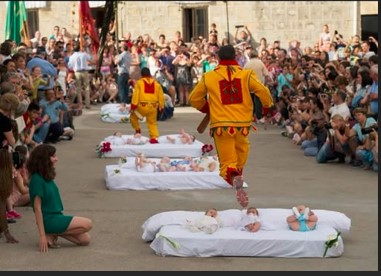
Think about being in a little town in Spain where babies sleep on mattresses in the streets while men dress up as The Devil and get ready to jump over them.
That sounds like something from a film, but it is part of El Colacho, a traditional celebration in Castrillo de Murcia in Burgos, Spain.
The ritual takes place during the festival of Corpus Christi of the Catholic Church and has been held since the early seventeenth century. On the official tourism site for Spain, it is described as a religious ritual where “El Colacho,” the devil, plays an important role. In this very exciting part of the ceremony he runs and jumps over children who were born the year before.
To an outsider, the sight can be surprising, to be sure.
But the ceremony is not intended as a competition or as entertainment at the expense of the children. Within the tradition, the ritual involves the theme of protection against evil forces and victory of good over evil.
Babies are laid on mattresses and the character playing the Devil jumps over them. The symbolism is related to the religious character of the festival and to the community’s feeling of protection and blessing.
The thing that attracts me in the El Colacho ritual is the fact that a village custom was able to survive amid modern Spanish society. It reminds us that communities do not always preserve their heritage in museums. Sometimes the heritage is found in the streets, in annual gatherings and in ceremonies that families continue to pass from one generation to another.
Also Read: The Sayawa (Zaar) Story During the Pre-Colonial Era
It is also a reminder that we should be careful when describing another culture simply as “strange.” When we have no knowledge about its history, all we can see is the weirdness and not the importance.
2. Niki Paleg: The Dani Mourning Tradition of Papua, Indonesia
The practice of finger-cutting is known as Niki Paleg and forms part of the custom of mourning in the Dani tribe whose habitat is in the mountainous areas of Papua.
This practice has been recorded as a grieving method practiced by some Dani groups, especially by women. Losing someone in the family could be shown in a physical way—like cutting off part of a finger as a sign of mourning. It is explained in the research that the finger could symbolize family union where the removal of the finger can symbolize the pain of losing a member from the family.
It is hard for many people these days to conceive of grief being shown in such a bodily way.
There are many cultures where people have to wear certain clothes, stay away from festivities for some time, shave their heads, perform funeral rites, or keep pictures of the departed ones. The Dani practice shows that mourning does not have one universal form.
What must be borne in mind here is that this must not be communicated in a way that implies that all Dani behave in this manner. Cultures change, and traditional practices may decline, disappear, or survive only in particular communities and circumstances.
The story of Niki Paleg gives us insights into life beyond the ritual process. It shows the extraordinary ways human beings have tried to give physical expression to loss.
Grief is universal, but the way people express it is deeply cultural.
3. Noche de Rábanos: Oaxaca’s Night of the Radishes
If you told me that radishes could become works of art, I might have asked you to explain it twice.
But in Oaxaca, Mexico, the humble radish has become part of a remarkable Christmas-season cultural tradition known as Noche de Rábanos, or the Night of the Radishes.
It takes place every year on December 23 in Oaxaca de Juárez. According to Mexico’s cultural information system, the tradition grew out of the Christmas Eve market and dates back to 1897, when decorated vegetable stalls and competitions helped give the radish a new artistic role.
Radishes are currently grown and carved by horticulturists and craftsmen to make intricate shapes.
The finished pieces can depict people, animals, religious scenes, local traditions and other subjects connected with Oaxaca.
What makes the tradition especially interesting is the amount of preparation involved. Radishes get grown specifically to yield shapes and sizes that work well for carving. It is only during these festivals that one gets to see these works of art.
This means that this is not just a celebration of vegetables.
It is a meeting point between agriculture and art.
A farmer’s product becomes an artist’s material, and a seasonal market becomes a cultural event.
The Mexican government still calls Noche de Rábanos a key piece of Oaxaca’s cultural heritage. Every December, it draws in locals and tourists alike.
To me, it is the best example of how culture may emerge out of the mundane. An everyday vegetable like the radish can come to represent creativity when the community attributes it with a symbolic value.
4. The World Wife-Carrying Championship in Finland
There are numerous interesting competitions in Finland, but one that definitely catches people’s attention is the World Wife Carrying Championship which takes place in Sonkajärvi.
The competition began in Sonkajärvi in 1992. The participants run an obstacle race while holding their partners, and the winner of the race wins a prize according to the weight of their partner. Visit Finland currently lists the prize as the wife’s weight in beer.
The event is partly sporting competition and partly community entertainment.
The official tournament history links the tournament to a local legend involving Herkko “Robber” Ronkainen. As per the competition itself, the old tale is one of men proving their physical prowess by lifting bags of grain, and in the legend, women. The present championship developed out of the legend into a sport activity.
The modern competition should therefore not be confused with an old Finnish marriage ceremony.
It is a contemporary sporting event built around local folklore and humour.
The event has also caught international attention and brought people to the village of Sonkajärvi. The championship continues to be held annually, making it an interesting example of how a local idea can become an internationally recognised cultural event.
What I like about this tradition is the sense of humour behind it.
Not every cultural practice has to be solemn. Some customs last because people like to participate in them.
5. Kanamara Matsuri: Japan’s Festival at Kanayama Shrine
There are few cultural festivals as intriguing as the Kanayama Shrine festival at Kawasaki, Japan.
The festival is associated with fertility, marriage, protection and sexual health. The shrine’s own materials date its yearly festival to April. Kawasaki City, for its part, calls Kanamara Matsuri a traditional event tied to prayers for children and marriage, as well as protection from HIV/AIDS.
The festival is known for symbolic phallic imagery, including portable shrines carried in procession. That imagery can look humorous or unusual to visitors, but there is a deeper religious and historical background.
The Japan National Tourism Organization explains that the shrine has a long connection with metalworking deities and that the festival’s historical roots include prayers for protection from sexually transmitted diseases. Over time, its meaning and public image have developed, and the event has become associated with fertility, marriage and sexual health awareness.
It was also related to awareness about HIV/AIDS in the modern era.
This is an important distinction. A visitor may see the colourful decorations and focus only on the humorous side, while the people involved may also understand the event through religion, fertility, health and community history.
That is one of the reasons cultural traditions deserve more than a quick description.
Sometimes the most visible part of a festival is not the most important part.
6. Famadihana: Remembering Ancestors in Madagascar
There are many cultural perspectives on death.
In the central highlands of Madagascar, some Malagasy communities practice Famadihana, often translated as “the turning of the bones.”
The tradition involves families opening ancestral tombs, bringing out the remains of relatives, wrapping them in fresh cloth and carrying out ceremonies that may include music, dancing, food and family gatherings.
It’s wrong to call this “celebration with dead bodies” because that does not understand the cultural importance of this occasion.
In Famadihana societies, ancestors still play an important role in family heritage. The ceremony can therefore be understood as an occasion for families to renew their relationship with their ancestors and with one another.
Famadihana has been studied anthropologically among the Malagasy people, as well as their relationship to kinship, memory and society.
Recent research also notes that the form of Famadihana developed historically over time rather than appearing in one unchanged form from antiquity. Its present form assumed a particular solidity in the highland societies of Madagascar in the nineteenth century.
The timing is also not simply a fixed annual festival. Ceremonies are planned according to family conditions, and they may be segregated year-wise.
What stands out to me is the importance placed on remembering.
In many African societies, including communities far away from Madagascar, ancestors and family history occupy an important place in cultural memory. Even if the methods might not be the same, the urge to honor those who came before us is something that many of us share.
7. The Lopburi Monkey Banquet in Thailand
Now let us move from human ancestors to monkeys.
In Lopburi, Thailand, macaques have become so closely associated with the city that they have their own annual feast.
The Lopburi Monkey Buffet Festival, generally held in late November, began in 1989 as a local tourism idea. Thailand’s Tourism Authority explains that the event was created as a way of thanking the monkeys that had become one of Lopburi’s major tourist attractions.
During the event, tables are prepared with fruit, vegetables, sweets and other food for the monkeys.
It is certainly a colourful sight.
But there is another side to the story which must not be overlooked.
Lopburi’s growing monkey population has created serious problems for residents, businesses and authorities. In recent years, officials have had to manage the relationship between the animals and the human population, including population-control and relocation measures.
So the festival is no longer simply a funny story about feeding monkeys.
It has become part of a larger conversation about tourism, wildlife and the difficulties of sharing an urban environment with a large animal population.
That is an important cultural lesson in itself.
Traditions can change as circumstances change.
What may have started as a celebration of the city’s monkeys can eventually raise difficult questions about how people and animals live together.
8. La Pourcailhade: France’s Pig Festival
There are traditions that make you smile just because they are so unexpected. (There are traditions that surprise you and make you smile.)
One of them is the Pourcailhade, held in Trie-sur-Baïse in southwest France.
The event is built around pigs and rural life. One of the attractions is the contest in which contestants mimic the sound of a pig.
It sounds like something made up as a joke, but the festival has a real link to the area’s agricultural identity.
And there is one important correction to make to the old version of this article: La Pourcailhade has not been discontinued.
The municipality’s own website continues to describe the festival and its pig-squealing championship. La Dépêche du Midi regional paper from France reported the festival’s 43rd edition in August 2026 and said the first pig festivals started in 1975.
The programme has included activities such as piglet races, local food events, sausage-related competitions and the French pig-squealing championship.
It appears that the competition to squeal like a pig is one which is meant to be funny.
But the agricultural traditions can reveal much about the identities of the people. Rural communities have historically developed celebrations around the animals, crops and occupations that shaped their everyday lives.
La Pourcailhade is therefore not merely about making funny sounds.
It is also a celebration of rural heritage, food, local businesses and community life.
Sometimes culture survives through laughter.
9. Tinku: Ritual Encounter and Community in Bolivia
In the highlands of Bolivia, particularly around San Pedro de Macha in northern Potosí, the Tinku tradition brings together communities in a ceremony connected with the agricultural cycle, spirituality and community relationships.
The word Tinku is related with the idea of an encounter or meeting.
But this is not always a peaceful meeting.
The ritual can include organised physical confrontations between members of different communities. Blood shed during the fighting has traditionally been understood in relation to offerings to Pachamama, the Mother Earth, and hopes for agricultural fertility.
Bolivia’s Ministry of Tourism and Cultures describes the Tinku of Macha as an ancestral cultural practice connected with Andean spirituality, community life and the agricultural calendar. The ritual has also been recognised as part of Bolivia’s intangible cultural heritage.
Academic studies also offer a crucial dimension. A 2023 study published in Alteridades describes Tinku as part of the Quechua worldview and explains its relationship with the agricultural cycle, community relationships and ritual combat.
It is therefore misleading to describe Tinku simply as people fighting for entertainment.
The physical confrontation is only one part of a much wider ceremony involving music, dance, community gatherings, religious symbolism and relationships between different groups.
Indeed, there is plenty of danger associated with the war. Reports have documented injuries and, in some cases, serious consequences.
Here is another illustration of the importance of providing cultural traditions in context.
A photograph may show two people fighting.
The history explains why there is an encounter.
10. Polterabend: Germany’s Wedding-Eve Tradition
Think about inviting your guests and friends for the party before getting married, whereby you will break some dishes outside your house.
That is the basic idea behind Polterabend, a German wedding tradition.
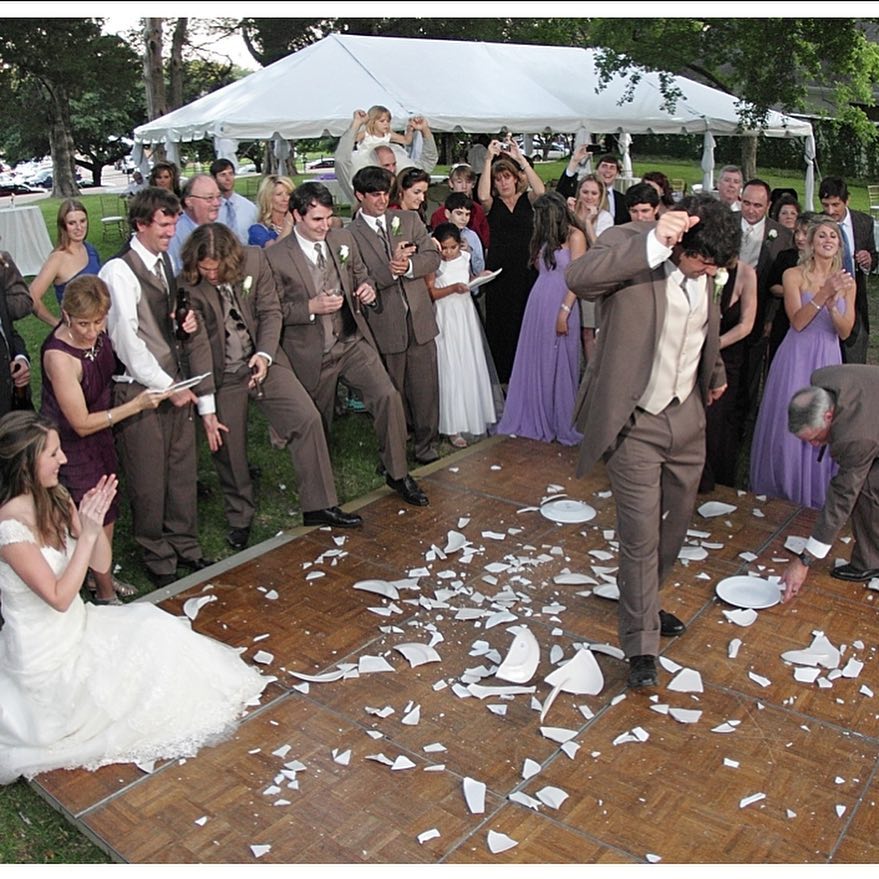
It is associated with a noisy night, and it involves smashing of some crockery before the wedding ceremony. The couple then cleans up the broken pieces together.
The symbol represents good fortune as well as a sign that the couple will have to learn to work together when the going gets rough. Germany’s Hamburg city information describes the tradition as one in which friends and family break stoneware and porcelain, but not glass, while the couple sweeps up the pieces.
You Can Also Read: History and Origin of Swahili Language
Deutsche Welle also describes Polterabend as a tradition found in many regions of Germany, with friends, neighbours and family bringing porcelain and crockery to make noise and bring good luck to the couple.
There is something almost practical about the symbolism.
Marriage, like life, will not always be neat.
Something will break. Something will go wrong. These problems will definitely have to be sorted out. The couple’s responsibility is not to pretend that life will always be perfect, but to face the mess together.
And it is for this very reason that I think that the final element of the tradition is more valuable than the smashing.
The noise gets everyone’s attention.
The cleaning is where the message lies.
What These Traditions Tell Us About Human Culture
After looking at these ten traditions, I think there is something worth remembering.
The world does not suddenly become culturally exciting simply because other people eat differently or dress differently.
It is much more profound when one examines the significance attached by people to their lives.
A radish becomes art in Oaxaca.
A sporting competition becomes part of Finnish local identity.
In Germany, the wedding is a time when people smash porcelain.
A village festival in Spain connects religious symbolism with an old community ceremony.
In Madagascar, remembering ancestors becomes a family gathering.
In Bolivia, a ritual encounter connects community relationships with agriculture and spirituality.
And in Thailand, a festival built around monkeys has become part of a larger conversation about tourism and wildlife.
In addition, such cases have taught us the fact that traditions are not rigid but flexible.
Some are centuries old. Some are modern creations. Some have changed significantly. Others have become tourist attractions while still retaining meaning for local communities.
This is something which I feel must always be remembered when one learns about a different culture.
We should ask questions before passing judgement.
Who started the tradition?
What did it mean originally?
What does it mean today?
Who still practices it?
Has the practice changed?
And perhaps most importantly, how do the people themselves describe it?
Those questions take us beyond the surface.
Why Preserving Cultural Traditions Still Matters
Modernisation has changed the way people live almost everywhere.
Young people move from villages to cities. Languages transcend international boundaries. Social media spreads new ideas within seconds. Families that once lived close together may now be separated by thousands of kilometres.
Yet cultural traditions can still provide a connection with the past.
This helps them establish the lineage of their grandparents. They can preserve local stories. These events help to create the community at times when it is needed most.
Preservation does not necessarily mean keeping every practice exactly as it was hundreds of years ago.
Culture naturally changes.
A tradition can survive while its meaning develops. A festival can become more organised. The rituals may be changed to fit the modern age. Others could vanish because the people feel that such customs no longer make sense for them to follow.
That is part of cultural history too.
For me, this is why cultural writing matters.
In writing about another community, we are not just collecting weird information. We are recording pieces of human memory.
Conclusion: Looking Beyond the Unusual
The ten traditions mentioned in the essay above are taken from quite diverse areas around the world, and on first glance, they do not have much in common.
A baby-jumping ceremony in Spain is different from a radish festival in Mexico.
A sporting event in Finland is not the same as an ancestral ceremony in Madagascar.
Bolivia’s Tinku tradition is not a German wedding tradition.
Yet each one tells us something about the people who created, inherited, changed or preserved it.
That is why cultural practices deserve to be studied.
I was careful in my choice of words to avoid calling these customs as either “strange” or “bizarre.” Those words could have catch our attention, but they hardly say anything to us. A tradition deserves to be understood before it is judged.
The more we learn about different cultures, the easier it becomes to recognise something important: people everywhere have their own ways of celebrating, mourning, remembering, marrying, farming, praying, competing and building relationships.
Our customs may look different on the outside, but many of them are answering familiar human questions.
How do we remember those who came before us?
How do we celebrate together?
How do we protect our families?
How do we mark important events?
How do we pass something valuable to the next generation?
Those questions belong to all of us.
And perhaps that is the real beauty of cultural diversity.
It provides us with differing responses to some of the same human situations.
About the Author
Habila Ibrahim is a cultural writer and the author behind Kunzaar, where he writes about African cultures, traditional communities, festivals, history, languages and cultural practices from different parts of the world.
His interest in cultural writing comes from a simple belief: every community has a story worth telling.
Through Kunzaar, Habila Ibrahim explores cultures not merely as collections of interesting facts, but as living histories shaped by families, communities, migration, belief, food, language, festivals and everyday life.
In the process of writing cultural stories, the aim should be to write such that people can easily understand what one is saying without offending the subjects.
For this article, the approach was to compare the existing Kunzaar material with cultural, tourism, governmental and academic sources, correct outdated information where necessary, and then present the subject in a more natural narrative style.
Sources and Research
This article was researched from a combination of official cultural and tourism sources, government publications and academic research. These are from:
Castilla y León Tourism and Spanish tourism sources on El Colacho.
Universiti Teknologi MARA research material on the Dani Niki Paleg death ritual.
The Government of Oaxaca and Mexico’s cultural authorities on Noche de Rábanos.
The official World Wife-Carrying Championship organisation and Visit Finland.
Kanagawa Shrine, Kawasaki City and the Japan National Tourism Organization concerning Kanamara Matsuri.
Anthropology studies of Famadihana and the Ancestors of Malagasy.
The Tourism Authority of Thailand concerning the Lopburi Monkey Buffet Festival.
The official Trie-sur-Baïse municipal information concerning La Pourcailhade.
Ministry of Tourism and Cultures of Bolivia and scholarly studies on Tinku.
Information about Hamburg and Polterabend from Deutsche Welle.
Please Note: The purpose of using these sources is not to copy their wording, but to check dates, locations, historical claims and cultural context before presenting the information in an original Kunzaar article.
Unquestionably believe that which you said. Your favorite reason seemed to be on the internet the easiest thing to
be aware of. I say to you, I certainly get annoyed while people consider worries that they just don’t know about.
You managed to hit the nail upon the top and also defined out the whole
thing without having side-effects , people could take a signal.
Will probably be back to get more. Thanks
This is messed up
I have been browsing online more than 2 hourss today, yet I never found any interesting article like yours.
It’s pretty worth enough for me. In my opinion, if all webmasters and
bloggers made good content as you did, the net will be
a lot more useful than ever before.
Thank you so much
This keyword specifically refers to obtaining the X8 version of Royal Dream.