

Introduction
On a peaceful night in 1986 on 21st August, an ordinary-looking lake in northwestern Cameroon turned into one of the most tragic natural disasters of the 20th century — not with fire or earthquake — but with an invisible, silent cloud of carbon dioxide (CO₂) that stole the lives of thousands in just one night. To see the 31st of December, 2025 or any other year, you have to give thanks to God for preserving your life.
Also Read: The Kalash Tribe
This disaster at Lake Nyos was devastating, a crater lake in the Northwest Region of Cameroon, remains one of the most haunting reminders that nature can be silently lethal. The event is known to history as one of only a handful of limnic eruptions — a rare geological phenomenon where gas explosively escapes from deep lake waters, suffocating everything in its path. i.e. all living creatures were affected.
The Setting: Lake Nyos and Its Volcano–Lake Landscape
Lake Nyos sits in the Menchum Division of the Northwest Region, part of the Oku Volcanic Field along the Cameroon Volcanic Line — a chain of volcanoes stretching toward the Gulf of Guinea. This picturesque lake was formed in a volcanic crater (a maar) perhaps only a few hundred years old. Beneath it, magma deep underground slowly leaked carbon dioxide, which dissolved into the lake’s bottom waters over decades.
The people of nearby villages — Nzacko, Nyos, Cha, Kam, Subum, and Fang — relied on the fertile volcanic soils for farming and livestock. Unaware of the danger lurking beneath their tranquil waters, they lived and farmed close to the lake shore.
The Night That Changed Everything: August 21, 1986
On the evening of August 21, 1986, at around 9:30 p.m., something deep within Lake Nyos gave way. Without any dramatic warning — no flames, no smoke — an enormous plume of dissolved carbon dioxide burst from the lake’s depths.
This sudden limnic eruption released an estimated 100,000 to 300,000 tons of CO₂ (some scientists suggest as much as 1.6 million tons in total), forming an invisible, dense gas cloud that spread outward. Because carbon dioxide is denser than air, it hugged the ground, rushing down valleys and spreading up to the distance of 25 kilometers from the lake.
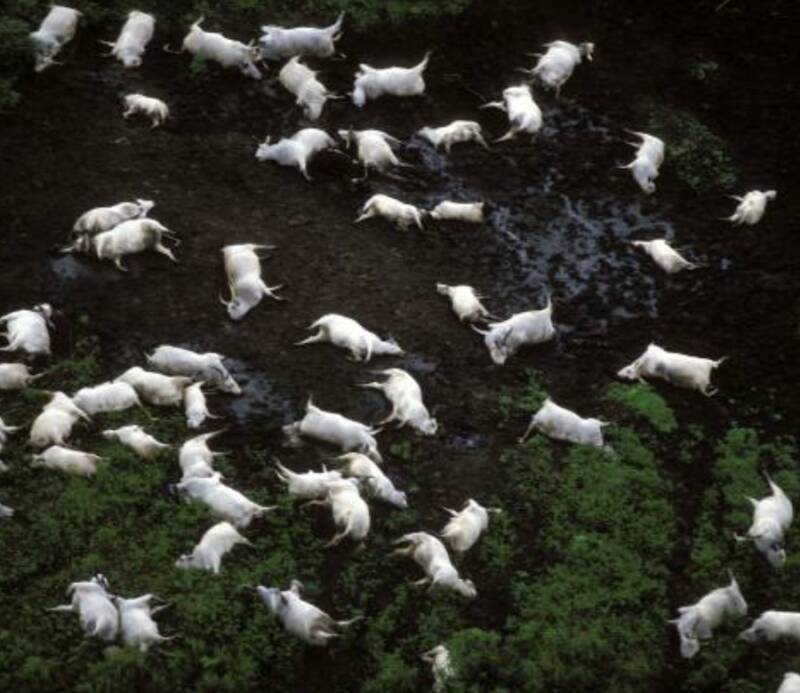
For the victims — many asleep in their homes — there was no chance to escape. The dense CO₂ displaced the oxygen in the air, leading to instant suffocation. People collapsed where they slept. Livestock and wildlife dropped lifeless in fields. Many survivors later described coughing, vomiting blood, and losing consciousness as the gas enveloped them.
Scale of the Tragedy
The toll was staggering:
- At least 1,746 people died from asphyxiation.
- More than 3,500 livestock — cattle, goats, and other animals — perished alongside humans.
- Entire villages were wiped out; some were abandoned forever.
Bodies were found lying peacefully on the ground, with no signs of panic, scratch or struggle — a haunting testimony to the silent lethality of CO₂ poisoning.
Every living thing caught in the heavy gas cloud died, yet buildings, trees, crops, and land remained untouched. As one investigator put it, it was as if life simply “went out” in the valley.
Understanding a Limnic Eruption
What made this disaster so unusual — and terrifying — was not a volcanic blast or a flood, but the physics of dissolving gases in deep water.
Lake Nyos had a stratified water column:
- Cold, gas-rich water at the bottom,
- and lighter, oxygen-rich water at the top.
Carbon dioxide seeped into the lake from underground volcanic activity and built up over decades. Unlike other lakes that turn over seasonally, Nyos remained still — locking gas in its depths. When some trigger — possibly a landslide, minor quake, or even heavy rain — disturbed that delicate balance, the CO₂ rapidly came out of solution in a massive fizz, like uncorking a shaken bottle. Once the process started, it accelerated, spewing gas into the atmosphere in seconds.
Regional Impact and Human Cost
The disaster didn’t just kill people — it shattered communities:
- Entire families were lost, leaving children orphaned and villages bereft of elders.
- Survivors reported long-term health issues, including respiratory problems, neurological impacts, and psychological trauma.
- Farms and livestock were decimated, affecting local food security and livelihoods.
The village of Chah (Cha) — once home to hundreds — was virtually wiped out and later largely abandoned due to fears and trauma.
Scientific and Global Response
The bizarre nature of the catastrophe stunned scientists worldwide. Limnic eruptions were virtually unknown events before Lake Nyos — with only one similar incident recorded two years earlier at Lake Monoun (also in Cameroon), which killed 37 people.
International teams of geologists, volcanologists, and hazard experts descended on the region. They confirmed that CO₂ was the culprit, originating from deep geological sources and dissolving over time into the lake’s waters.
You Can Also Read: Introduction to Algebra
In the years following the disaster, researchers developed a mitigation technique: artificial degassing. Long vertical pipes were installed in Lake Nyos, allowing controlled release of gas from the deep waters to the surface, where it can harmlessly dissipate — much like letting steam escape from a pressure cooker.
Several degassing systems were installed in 2001 and 2011, significantly reducing the risk of another sudden eruption.
Lingering Dangers and Lessons Learned
Though the danger of an immediate limnic eruption has been diminished, Lake Nyos is not entirely “safe” up till now because of the fear and what might trigger such thing again.
- CO₂ continues to seep into the lake from underground, and monitoring is ongoing.
- The natural rock “dam” holding back the lake is weakening — a failure could unleash water and trapped gas downstream.
- Scientists also study Lake Kivu on the Rwanda–DRC border — a much larger lake with similar gas buildup — as a potential future hazard.
The tragedy also changed how scientists and disaster planners view hidden natural risks. Invisible, silent killers — like CO₂ — need monitoring and mitigation just as much as earthquakes and storms.
Conclusion
Remembering the Lost
Lake Nyos stands today as a deceptively calm body of water — a ribbon of blue amidst Cameroon’s green volcanic hills. But beneath the surface, memories of August 21, 1986, remain etched in science and in the lives of survivors. It is a stark reminder that nature’s most lethal threats are not always visible. And that sometimes, the greatest disasters come not with thunder, but with silence.